
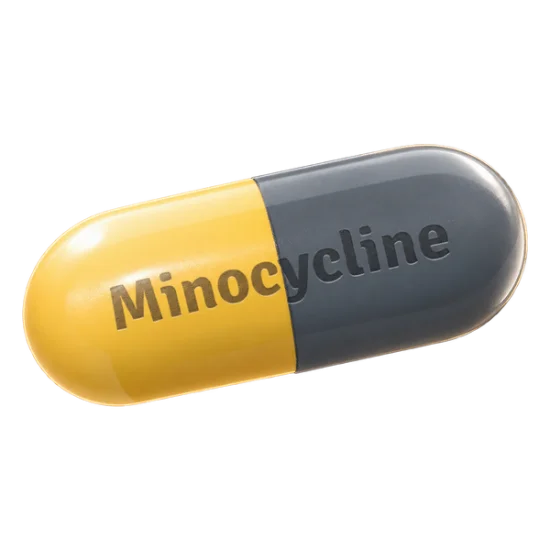
Minocycline
Active ingredient: Minocycline
Delivery: from 4 days
- Only original products
- Worldwide Delivery
- 24/7 Support
Minocycline slows susceptible bacteria by blocking their protein production. This tetracycline antibiotic is prescribed for selected bacterial infections and inflammatory acne when oral treatment is appropriate. Its tissue penetration supports activity beyond the gut.
Product information
Minocycline slows susceptible bacteria by blocking their protein production. This tetracycline antibiotic is prescribed for selected bacterial infections and inflammatory acne when oral treatment is appropriate. Its tissue penetration supports activity beyond the gut, while resistance and adverse effects limit use to suitable cases.
Therapeutic indications
Minocycline is prescribed for susceptible bacterial infections and inflammatory skin disease. The choice depends on the suspected organism, local resistance, infection site, previous antibiotic exposure, and the person’s medical history. It does not treat viral illnesses such as influenza or the common cold.
Dermatologists may select minocycline for inflammatory acne with numerous red, tender, or pus-filled lesions, especially when topical treatment alone has not controlled the condition. The medicine addresses the bacterial and inflammatory components of acne, but it is usually part of a planned regimen rather than a permanent treatment.
| Clinical use | Therapeutic target | Typical context |
|---|---|---|
| Susceptible bacterial infections | Bacterial growth and multiplication | Infection confirmed or considered likely to respond to tetracyclines |
| Inflammatory acne | Acne-associated inflammation and bacterial contribution | Moderate or severe lesions requiring oral treatment |
| Selected specialist indications | Organisms sensitive to minocycline | Treatment guided by clinical assessment and local resistance data |
The World Health Organization advises using antibiotics according to antimicrobial stewardship principles, because unnecessary exposure encourages resistance and can make later infections harder to treat [2]. A course should therefore be used for the prescribed indication rather than saved for a future illness.
Acne improvement is gradual. Fewer new inflammatory lesions may appear before the skin looks clear, and residual redness or marks can persist after bacterial activity has decreased. Minocycline will not correct every cause of acne, including hormonal drivers, comedonal blockage, or scarring that has already formed.
How it affects the body
Minocycline enters susceptible bacterial cells and binds reversibly to the 30S subunit of the bacterial ribosome. Ribosomes are the structures bacteria use to assemble proteins. By interfering with the attachment of transfer RNA, minocycline disrupts the addition of amino acids to the growing protein chain.
The result is bacteriostatic activity: bacterial growth is restrained rather than rapidly terminated. The immune system can then clear organisms that are no longer multiplying normally. The precise clinical response depends on drug exposure, bacterial susceptibility, infection location, and the person’s immune function.
This mechanism explains why minocycline belongs to the tetracycline antibiotic class and why it cannot replace antibiotics with different cellular targets in every infection. It also explains why a medicine can fail when bacteria carry resistance mechanisms that prevent intracellular accumulation or protect the ribosome.
The United States Food and Drug Administration prescribing information for minocycline describes its ribosomal action, pharmacokinetics, warnings, and adverse reactions [3].
When not to use it
The medicine is not for you if you have a previous serious allergic reaction to minocycline, tetracyclines, or an excipient in the prescribed formulation.
- pregnancy, especially later pregnancy, because tetracyclines can affect fetal teeth and bone development;
- breastfeeding, where exposure and infant effects require an individual decision;
- children below the age range authorised for the specific formulation;
- significant liver disease;
- a history of intracranial hypertension;
- systemic lupus or previous drug-induced lupus;
- autoimmune hepatitis or unexplained liver abnormalities;
- severe vestibular disease or previous disabling reactions to minocycline.
Oral retinoids such as isotretinoin can increase concern about intracranial hypertension when combined with tetracyclines. Iron, calcium, magnesium, aluminium, and bismuth can reduce absorption. Warfarin and other anticoagulants may require closer monitoring because antibiotic treatment can alter anticoagulant response. Penicillin-class antibiotics may be selected differently depending on the infection, so concurrent use requires a deliberate prescribing decision rather than self-combination.
When this is not for you
Minocycline may not be suitable if you have had a serious allergy to tetracycline antibiotics, are pregnant or breastfeeding, have significant liver disease, lupus, autoimmune hepatitis, raised pressure inside the skull, or severe balance problems. Children may only use particular formulations within their authorised age range. Tell a clinician about isotretinoin, blood thinners, mineral supplements, and any previous disabling reaction to minocycline before starting treatment.
Possible side effects
Common adverse effects include nausea, stomach discomfort, diarrhoea, headache, dizziness, and light-headedness. Minocycline can cause vestibular reactions more often than some other tetracyclines, so the first doses deserve practical caution when driving or working at height.
Skin and mucosal pigmentation can develop during prolonged exposure, including blue-grey or brown discoloration in areas such as the gums, scars, nails, or previously inflamed skin. This change may persist after treatment. Sun sensitivity can also occur, although its pattern varies between individuals. A clinician can review these effects during follow-up. Persistent or spreading pigmentation should be reported.
Seek urgent medical attention for:
- breathing difficulty, facial swelling, or extensive blistering rash;
- severe headache with blurred or double vision;
- yellow skin, pale stools, or dark urine;
- severe watery or bloody diarrhoea;
- marked joint pain, fever, swollen glands, or unusual fatigue;
- severe dizziness that causes falls or prevents normal walking.
Minocycline has been associated with drug-induced lupus-like syndromes, autoimmune hepatitis, hypersensitivity reactions, and intracranial hypertension. These events are uncommon, but early recognition reduces the chance of serious complications.
One practical detail is easy to miss: persistent dizziness is not simply a nuisance to push through. It can make driving unsafe and may signal intolerance requiring a change in treatment. Another is that darkening of acne scars or gums can appear after extended use, not only during the first few days.
Ingredients
Minocycline contains the active antibiotic minocycline. Oral capsules commonly use minocycline hydrochloride, a salt form of minocycline that dissolves for systemic absorption after administration. It belongs to the tetracycline antibiotic class, alongside agents that inhibit bacterial protein synthesis rather than directly destroying bacterial cells.
The medicine is used when the suspected organism is susceptible to tetracyclines. It has activity against several Gram-positive and Gram-negative bacteria, though resistance patterns differ by organism, region, and clinical setting. The European Medicines Agency describes minocycline-containing medicines through product-specific prescribing information covering indications, dosing, contraindications, and adverse reactions [1].
Minocycline is also used in dermatology. Its anti-inflammatory activity can reduce the bacterial contribution and inflammatory response associated with moderate-to-severe acne.
- Active substance: minocycline
- Common oral salt: minocycline hydrochloride
- Drug class: tetracycline antibiotic
- Product form: oral capsules
- Main pharmacological action: inhibition of bacterial protein synthesis
- Clinical role: selected bacterial infections and inflammatory acne
Dosage and administration
Dosing differs between strengths and between users, so there is no single amount that suits everyone. The prescribed regimen depends on the infection, acne severity, kidney and liver considerations, age, interacting medicines, and the specific capsule strength.
- Take the capsule by mouth at the prescribed frequency.
- Swallow it with plenty of water.
- Remain upright after taking it rather than lying down immediately.
- Separate it from iron, calcium, magnesium, aluminium, or bismuth products according to the prescriber’s timing instructions.
- Complete the prescribed course unless a clinician changes it because of an adverse reaction or a revised diagnosis.
- If a dose is missed, take it when remembered unless the next dose is close; do not double the next dose.
Food may alter absorption less than it does with some older tetracyclines, but mineral-containing foods, supplements, and antacids remain relevant. The exact timing should be planned around the person’s other medicines.
The capsule should not be opened, crushed, or chewed unless the specific product information permits it. Manipulating an oral dosage form can affect swallowing comfort and drug delivery.
Comparison
Minocycline differs from other antibiotic categories by its target, tissue distribution, and adverse-effect pattern. The best choice depends on the organism and infection rather than on a general ranking of antibiotics.
| Approach | Main characteristic | Main limitation |
|---|---|---|
| Minocycline | Tetracycline action with strong tissue distribution | Dizziness, pigmentation, interactions, and resistance concerns |
| Macrolide antibiotic | Bacterial protein-synthesis inhibition at a different ribosomal site | Resistance and drug-specific cardiac or gastrointestinal risks |
| Beta-lactam antibiotic | Cell-wall synthesis inhibition | Allergy, bacterial resistance, and limited activity against some organisms |
For inflammatory acne, minocycline may be considered when an oral tetracycline approach fits the clinical picture. A different antibiotic category may be preferred for a confirmed organism, pregnancy, a drug interaction, or a patient history that increases the risk of vestibular or autoimmune adverse effects.
Antibiotics should not be compared by perceived strength alone. A narrow option that targets the confirmed organism can be more appropriate than a broader option that exposes the body to unnecessary antimicrobial pressure.
Common mistakes
Several routine errors reduce the benefit of minocycline or increase avoidable risk.
- Taking the capsule with an iron or calcium supplement at the same time.
- Lying down immediately after swallowing it.
- Doubling a dose after forgetting one.
- Continuing despite severe dizziness or visual changes.
- Stopping early when symptoms improve, then keeping the remaining capsules for later.
- Using it for a viral cold or an undiagnosed rash.
- Treating every new acne flare as proof that a longer antibiotic course is needed.
- Driving before knowing whether the medicine causes vertigo or slowed concentration.
- Combining it with an oral retinoid without a prescriber’s direction.
Another common error is judging acne treatment only by surface oiliness. Minocycline mainly targets inflammatory activity and susceptible bacteria; it does not instantly remove blocked pores or established scars.
What doctors say
In clinical practice, physicians usually judge minocycline by three questions: is the condition likely to respond, is the person suitable for a tetracycline, and is there a narrower or better-tolerated option? The answer can change when culture results, pregnancy status, liver tests, or new adverse effects become available.
For acne, dermatologists generally set a defined treatment review rather than leaving oral antibiotic therapy open-ended. The aim is to reduce inflammatory activity and then maintain improvement with an appropriate long-term strategy that limits repeated antibiotic exposure.
Doctors also pay close attention to dizziness and visual complaints. A patient who reports spinning sensations, imbalance, severe headache, or blurred vision should not simply continue unchanged. These symptoms can affect safety and may require an urgent clinical review.
The American Academy of Dermatology recommends combining acne treatment with antimicrobial stewardship and reassessing response instead of using oral antibiotics without a planned endpoint [4]. This is why treatment success means more than fewer spots during the first few weeks; it includes tolerability, reduced recurrence, and an appropriate follow-up plan.
Common questions
What time of day is best for Minocycline?
A consistent time that fits the prescribed frequency is usually easiest to maintain. Take the capsule with plenty of water and stay upright afterward, while separating it from mineral products that can bind the antibiotic. The FDA prescribing information (2020) describes oral administration and interaction precautions for minocycline products [5]. A morning or evening schedule can both work when it matches the prescribed regimen and avoids interacting supplements.
Can Minocycline cause dizziness?
Yes. Dizziness, vertigo, and imbalance are recognised adverse effects of minocycline and can appear early in treatment. The FDA safety information (2020) and regulatory data describe vestibular reactions as a practical reason to use caution with driving, climbing, and machinery. If dizziness is severe, persistent, or associated with hearing changes, vomiting, or falls, stop risky activities and obtain prompt medical advice.
How soon can the effect become noticeable?
For bacterial infections, improvement depends on the infection site, organism, susceptibility, and the person’s immune response. For inflammatory acne, fewer new lesions may appear over several weeks, while full skin improvement often takes longer. The American Academy of Dermatology (2024) describes acne response as a gradual process requiring planned reassessment rather than immediate judgement. Worsening symptoms, fever, spreading redness, or no improvement within the expected clinical window requires a review of the diagnosis and treatment.
What should be done if the expected result does not occur?
Do not increase the dose, extend the course, or restart leftover capsules independently. The prescriber may need to reassess bacterial susceptibility, adherence, absorption interactions, the diagnosis, or another cause of persistent symptoms. EMA antibiotic guidance (2023) supports reviewing treatment when the clinical response is inadequate instead of automatically escalating exposure. For acne, persistent lesions may require a different maintenance plan or treatment aimed at comedones, hormones, or scarring.
Can Minocycline affect driving, concentration, or machinery work?
It can. Dizziness, vertigo, headache, blurred vision, or nausea may reduce driving safety and coordination, especially after starting treatment or changing the regimen. MOHAP medicine-safety principles (2024) support avoiding hazardous tasks until the individual response is clear. Do not drive, operate machinery, work at height, or handle dangerous equipment if balance, vision, alertness, or concentration is affected.
How does Minocycline differ from the closest alternative by mechanism?
Minocycline is a tetracycline that acts mainly by binding to the bacterial 30S ribosomal subunit and limiting protein production. Other antibiotic categories may block cell-wall construction, interfere with a different ribosomal site, or inhibit bacterial DNA processes. WHO antimicrobial-stewardship guidance (2023) supports selecting treatment according to the organism, infection site, resistance pattern, and patient-specific risks. A different active substance may be preferred when tetracycline resistance, pregnancy, liver disease, interactions, or vestibular intolerance changes the balance.
Do you offer anonymous delivery?
Your order will be securely packed and shipped within 24 hours. This is exactly what your package will look like (images of an actual item sent). It has the size and look of a regular private letter (24x11x0.7 cm) and its contents cannot be seen.
Comparison

How Buyers Rate Minocycline
-
Ramon, 69 Jumeirah 21 Nov 2026Rating: 5 out of 5I used the capsules for an inflammatory skin problem and noticed fewer painful lesions after several weeks. The improvement was gradual, but the flare-ups became easier to manage and I was satisfied with the result.
-
Khalid R., 37 Ruwais 25 Oct 2026Rating: 3.5 out of 5The treatment helped reduce the inflamed acne on my face, although it took longer than I expected. I had mild dizziness during the first days, so I avoided driving until it passed and discussed the continuation with my doctor.
-
Faisal, 68 Liwa 8 Nov 2026Rating: 5 out of 5The capsules reduced the number of new tender spots over the course of treatment. My skin did not change overnight, but the steady improvement was clear enough that I felt the treatment had been worthwhile.
Sources
- European Medicines Agency (2023). Summary of Product Characteristics (SmPC) — minocycline
- World Health Organization (2023). Antimicrobial resistance
- U.S. Food and Drug Administration (2020). MINOCIN (minocycline hydrochloride) prescribing information
- American Academy of Dermatology (2024). Guidelines of care for the management of acne vulgaris
- U.S. Food and Drug Administration (2021). Medication Guide and prescribing information for oral minocycline products
