
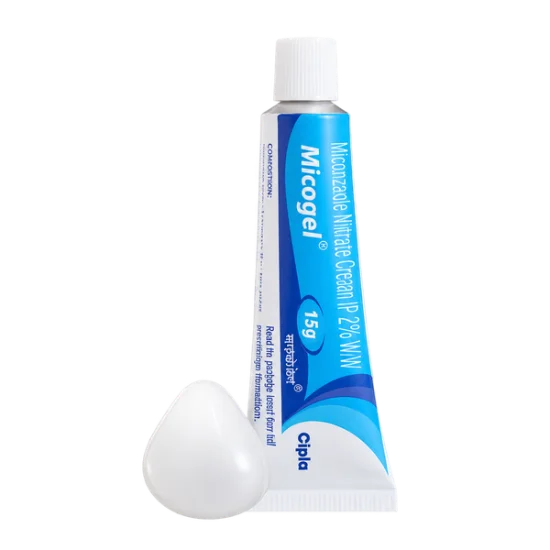
Micogel
Active ingredient: Miconazole
Delivery: from 4 days
- Only original products
- Worldwide Delivery
- 24/7 Support
Athlete’s foot, ringworm, jock itch, and superficial yeast infections can cause itching, scaling, redness, or cracking of the skin. Micogel contains miconazole nitrate 2% w/w, an imidazole antifungal gel for topical treatment of susceptible fungal infections. It works by disrupting ergosterol production, weakening the fungal cell membrane and limiting fungal growth.
Product information
Micogel is a topical dermatological antifungal supplied in a tube as a gel. Its active ingredient is miconazole nitrate 2% w/w. Miconazole belongs to the imidazole antifungal class and acts directly at the skin surface where the infection is present.
Therapeutic indications
Micogel is used for superficial fungal infections of the skin. The condition may look different depending on the body site and the organism involved.
Common indications include:
- Athlete’s foot, medically called tinea pedis. It often causes itching, peeling, soft white skin, or cracks between the toes.
- Ringworm, medically called tinea corporis. This can produce expanding, scaly patches with a more active edge.
- Jock itch, medically called tinea cruris. It usually affects the groin and upper inner thighs, while sparing the central scrotal skin in many cases.
- Superficial yeast infections, including skin infections involving Candida species. These may appear as red, moist, itchy patches in skin folds.
- Fungal infection of the body or limbs, where the affected area remains superficial and does not involve deeper tissue.
The names can be confusing because ringworm is caused by fungi, not worms. The visible appearance also varies with skin colour, moisture, friction, and the location of the infection.
A fungal rash often continues to itch after treatment begins because inflammation settles more slowly than fungal growth. Scratching can damage the skin and create small openings for bacterial infection.
Micogel is intended for superficial skin disease. Painful swelling, pus, rapidly spreading redness, fever, or involvement of the eye requires a different clinical assessment because these features may indicate bacterial infection or a deeper process.
How it affects the body
Miconazole is an imidazole antifungal. It interferes with fungal enzymes involved in the production of ergosterol, a lipid that helps maintain the fungal cell membrane.
Without adequate ergosterol, the membrane becomes unstable. The fungal cell loses normal structure and function, which restricts growth and can lead to fungal cell damage.
- Miconazole reaches the fungal cells in the treated skin.
- It inhibits enzymes involved in ergosterol synthesis.
- The altered fungal membrane becomes less able to support continued growth.
Human skin cells do not depend on ergosterol in the same way. This difference allows topical miconazole to act selectively against fungal organisms when used on the skin.
Miconazole and clotrimazole are both imidazole antifungals. Their mechanisms overlap, although individual response can vary according to the organism, the body site, moisture, skin damage, and adherence to treatment. The WHO describes topical antifungal treatment as a standard approach for many superficial fungal conditions [1].
When not to use it
Micogel is not suitable for you if you have had an allergic reaction to miconazole, other imidazole antifungals, or any component of the gel.
Use requires extra care in the following situations:
- The rash affects the eyes, lips, mouth, or genital mucosa.
- The skin is deeply broken, ulcerated, or severely inflamed.
- There is extensive infection over a large body area.
- You take warfarin or another medicine requiring close coagulation control.
- You have a history of severe contact dermatitis from topical medicines.
- The infection involves the scalp, nails, or deeper tissue.
- The affected person is an infant or young child and the diagnosis is uncertain.
- Pregnancy or breastfeeding requires treatment over a large area or for a prolonged period.
Micogel should not be swallowed. If accidental ingestion occurs, seek medical advice promptly, especially if nausea, vomiting, dizziness, or unusual drowsiness develops.
Keep the gel away from the eyes. If it enters the eyes, rinse with clean water and obtain medical advice if pain, redness, or blurred vision persists.
When this is not for you
- Not for you if: You have a suspected deep infection, an uncertain diagnosis, or a previous allergic reaction to miconazole or another imidazole antifungal.
Warfarin is the key interaction requiring attention. Miconazole has been associated with increased anticoagulant effects in some patients, including those using topical formulations over substantial areas or damaged skin. A rise in anticoagulation may increase bruising or bleeding risk.
People taking warfarin should have their anticoagulation management reviewed before using miconazole over large, inflamed, or broken areas. INR monitoring may be required during treatment and after stopping it. The FDA prescribing information for warfarin identifies azole antifungals as clinically relevant interaction partners [2].
Contact a clinician promptly if unusual bruising, nosebleeds, bleeding gums, dark stools, blood in urine, or prolonged bleeding develops. Do not change the warfarin dose independently.
Possible side effects
Most unwanted effects from topical miconazole are local. They can arise from the active ingredient, the gel base, or contact between the product and already-irritated skin.
Possible effects include:
- Burning or stinging after application
- Itching or increased irritation
- Redness, dryness, or peeling
- Contact dermatitis
- Rash or small blisters
- Swelling at the treated site
- Allergic reaction
A brief mild sting on cracked skin can occur because the skin barrier is damaged. Persistent burning is different from a short sensation immediately after application and deserves attention.
Stop using Micogel and seek urgent medical care for facial swelling, breathing difficulty, widespread hives, severe blistering, or rapidly worsening skin inflammation. These symptoms may indicate a significant hypersensitivity reaction.
Avoid applying the gel to severely broken skin unless directed by a clinician. Broken skin can absorb more medicine and may react more strongly.
Symptoms that fail to improve, spread beyond the treated area, or repeatedly return may reflect an incorrect diagnosis, reinfection, eczema, psoriasis, or bacterial involvement. Continuing to apply an antifungal indefinitely can delay the correct treatment.
Ingredients
Micogel is a topical dermatological antifungal supplied in a tube as a gel. Its active ingredient is miconazole nitrate 2% w/w. Miconazole belongs to the imidazole antifungal class and acts directly at the skin surface where the infection is present.
The gel is intended for external use on affected skin. It is used for common superficial infections caused by dermatophytes and some yeasts. The formulation is applied locally rather than taken by mouth.
Micogel is suitable for fungal skin problems affecting areas such as the feet, groin, trunk, and other external skin surfaces. It is not designed for application inside the eyes, mouth, or other internal body areas.
Miconazole also has activity against some Gram-positive bacteria, which may be relevant when a mixed superficial infection is present. The main therapeutic role of Micogel remains antifungal treatment.
Dosage and administration
Use Micogel on clean, dry skin. The amount per application is selected for the affected area rather than being one fixed quantity for every person.
- Wash and dry the affected area carefully.
- Apply a thin layer of gel over the rash and the nearby skin margin.
- Rub it in gently unless the skin is raw or painful.
- Wash your hands after application, unless the hands are the treated area.
- Apply it at the prescribed frequency and continue for the prescribed duration.
- Keep the tube away from the eyes, mouth, and other mucous membranes.
- Do not cover treated skin with an airtight dressing unless a clinician has specifically instructed this.
Miconazole topical treatment commonly requires regular application over several weeks, depending on the infection and its location. The correct duration depends on the clinical diagnosis and response. A rash that improves briefly and then returns may need reassessment rather than repeated short courses.
One practical mistake is applying antifungal gel only to the most visible spot. Treating the surrounding margin helps address fungal growth at the active edge of the rash. Another common problem is applying the gel immediately after bathing while the skin is still damp; moisture can encourage fungal persistence, especially between the toes and in skin folds.
Comparison
Miconazole and clotrimazole are chemically different active ingredients within the same broad imidazole class. Both interfere with ergosterol production, so their clinical uses overlap.
| Active ingredient | Drug class and practical role | Typical use |
|---|---|---|
| Miconazole | Imidazole antifungal; may also affect some Gram-positive bacteria | Athlete’s foot, ringworm, jock itch, and superficial yeast infections |
| Clotrimazole | Imidazole antifungal | Dermatophyte and superficial yeast infections |
Micogel may be selected when a miconazole-based topical treatment is appropriate for the diagnosed infection. Clotrimazole represents a related pharmacological option, though response and tolerability can differ between individuals.
A topical antifungal is generally preferred when the infection is limited to the outer skin. Oral antifungal treatment may be considered for extensive, recurrent, nail, scalp, or hair-bearing infections, but that decision requires clinical assessment because systemic treatment has different interactions and monitoring requirements.
The European Medicines Agency describes topical azole antifungals as locally acting treatments whose benefit depends on applying them to the affected area for the recommended course [3].
Common mistakes
Several practical errors can reduce treatment success:
- Applying the gel only when itching is severe.
- Stopping immediately after the rash looks better.
- Treating the rash but ignoring moisture between the toes or in skin folds.
- Sharing towels, footwear, or clothing during active infection.
- Applying the gel to wet skin.
- Covering the area tightly without medical instruction.
- Using steroid cream alone on a suspected fungal rash.
- Applying multiple topical products at the same time, making irritation difficult to identify.
- Treating an uncertain rash repeatedly without reassessment.
- Forgetting to wash hands after application, then touching the eyes.
A steroid-containing cream can reduce redness while allowing fungal growth to continue or become harder to recognise. This can produce a less typical rash that is more difficult to diagnose.
Clothing and towels deserve attention. Wash them regularly, dry them thoroughly, and avoid reusing damp fabric against the treated skin.
What doctors say
In clinical practice, physicians usually assess the shape of the rash, the body site, the degree of scaling, and the presence of moisture or skin breaks before choosing a topical antifungal. A circular rash is not automatically ringworm, and itching alone does not prove a fungal infection.
Doctors also look for patterns that suggest reinfection. Repeated athlete’s foot can be linked to damp footwear, shared changing-room floors, persistent infection between the toes, or untreated fungal disease elsewhere on the body.
Consistency matters more than applying a large quantity once. Missing several applications can allow the fungal population to recover even when the rash looks less inflamed.
A clinician may recommend testing or a different treatment when the rash does not respond, when it returns repeatedly, or when the diagnosis is uncertain. The WHO and dermatology guidance support reassessment for persistent or atypical superficial skin disease [4].
Common questions
Which symptoms mean that Micogel should be stopped and medical help sought urgently?
Severe swelling, blistering, widespread hives, facial swelling, or breathing difficulty requires urgent medical attention. These symptoms may indicate a serious allergic reaction rather than ordinary local irritation. Increasing pain, pus, fever, or rapidly spreading redness also needs prompt assessment because bacterial infection may be present. Do not delay assessment when these symptoms occur. MOHAP guidance from 2024 places rapid assessment above self-treatment when skin inflammation spreads quickly or systemic symptoms appear.
Can Micogel affect driving, concentration, or work with machinery?
Topical miconazole is not generally expected to impair concentration, coordination, or the ability to drive when used on a limited area of intact skin. Local burning or irritation could still distract someone working in a safety-sensitive environment. Stop the task if discomfort affects vision, movement, or attention. The EMA safety information from 2010 for topical antifungals supports this practical approach, with the main precautions relating to local reactions rather than sedation.
How soon does Micogel usually start to feel effective?
Itching and redness may begin to improve during the first several days, although visible scaling can take longer to settle. Complete clearance often requires regular treatment over the full recommended course. Early improvement does not prove that the fungus has been eliminated. WHO clinical guidance from 2014 advises continuing appropriate topical treatment for the recommended duration and reassessing persistent disease.
Can Micogel be used by someone under 18?
Use in children and adolescents depends on the body site, age, size of the affected area, and certainty of the diagnosis. A persistent rash in a child should not be treated repeatedly without clinical assessment. Avoid applying it near the eyes or mouth, and prevent accidental swallowing. Pediatric use should follow the directions of a healthcare professional, consistent with the safety principles described by MOHAP in 2024.
Can alcohol be used while applying Micogel?
Alcohol consumption is not known to produce the same direct interaction with topical miconazole as it can with some systemic medicines. Drinking alcohol does not treat the infection and may make it harder to notice worsening symptoms or maintain regular applications. The main interaction requiring specific attention is warfarin, especially when treating large or damaged areas. The FDA's 2017 Coumadin prescribing information identifies azole antifungals as interaction risks requiring clinical attention.
How much Micogel should be applied, and should the area be covered?
Use a thin layer sufficient to cover the affected skin and a small surrounding margin. The amount per application is individual because a small patch and a large skin fold require different quantities. Wash and dry the area first, wash your hands after application, and avoid airtight covering unless specifically directed. NICE dermatology guidance from 2024 supports clean, dry application and avoidance of unnecessary occlusion for superficial fungal skin disease.
How does Micogel differ from clotrimazole treatment?
Micogel contains miconazole nitrate, while clotrimazole contains a different active ingredient. Both belong to the imidazole antifungal class and interfere with fungal ergosterol production. Their indications overlap, but a person may tolerate or respond to one better than the other. WHO guidance from 2014 describes both miconazole and clotrimazole as topical options used against susceptible superficial fungal infections.
Do you offer anonymous delivery?
Your order will be securely packed and shipped within 24 hours. This is exactly what your package will look like (images of an actual item sent). It has the size and look of a regular private letter (24x11x0.7 cm) and its contents cannot be seen.
Comparison
How Buyers Rate Micogel
-
Hassan, 48 Al Barsha 25 Oct 2026Rating: 3 out of 5I used Micogel for an itchy rash between my toes. The redness settled first, but the skin still felt irritated for a while, so I kept the area dry and used it regularly. It helped, although the improvement was slower than I expected.
-
Samir, 45 Ras Al Khaimah 3 Nov 2026Rating: 4.5 out of 5Micogel cleared the scaly patch on my foot after consistent application. The gel was easy to spread and did not leave my socks heavily stained. The itching reduced noticeably during the first part of treatment.
-
Waleed, 68 Jebel Ali 8 Nov 2026Rating: 5 out of 5I used Micogel for a fungal rash on my upper thigh. The area became less itchy and the edges stopped spreading. Applying it after washing and drying the skin became part of my evening routine.
-
Usman, 54 Mussafah 22 Nov 2026Rating: 4.5 out of 5Micogel helped with the peeling and irritation between my toes. I also changed damp socks more often, which made the treatment easier to manage. The skin looked much clearer by the end of the course.
Sources
- World Health Organization (2014). Guidelines for the Diagnosis, Prevention and Management of Cryptococcal Disease in HIV-Infected Adults, Adolescents and Children
- U.S. Food and Drug Administration (2017). Coumadin (warfarin sodium) Prescribing Information
- European Medicines Agency (2010). Summary of Product Characteristics (SmPC) — miconazole topical product
- World Health Organization (2014). WHO Guidelines for the Treatment of Skin and Oral HIV-Associated Conditions
