
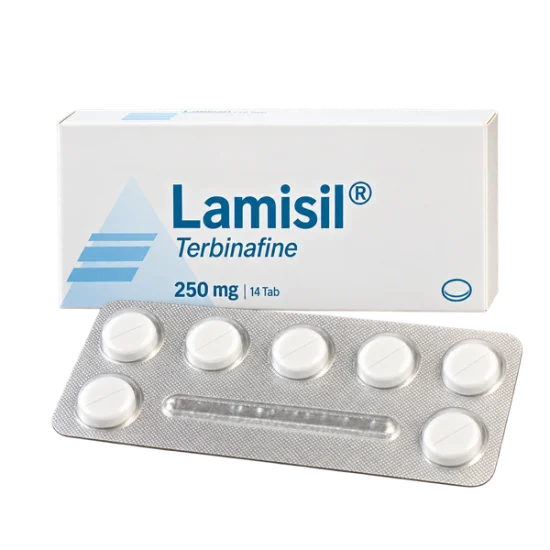
Lamisil
Active ingredient: Terbinafine
Delivery: from 4 days
- Only original products
- Worldwide Delivery
- 24/7 Support
Terbinafine, the active ingredient of Lamisil, is an allylamine antifungal for dermatophyte infections of the skin and nails. Lamisil tablets help clear fungal disease by blocking a fungal enzyme needed to build a stable cell membrane.
Product information
Lamisil contains terbinafine, supplied as terbinafine hydrochloride, and belongs to the allylamine antifungal class.
Therapeutic indications
Lamisil tablets are used for confirmed or strongly suspected dermatophyte infections when systemic treatment is appropriate. The exact diagnosis matters because eczema, psoriasis, bacterial infection, and some yeasts can produce similar scaling or redness but may need a different treatment.
| Condition | Typical features and treatment focus |
|---|---|
| Athlete’s foot, or tinea pedis | Itching, scaling, cracks, or burning between the toes and on the soles; treatment targets dermatophytes in the skin. |
| Ringworm, or tinea corporis | Expanding circular or patch-like rash with a scaly edge; treatment may be topical or oral according to extent and location. |
| Jock itch, or tinea cruris | Itchy, sharply bordered rash in the groin; treatment includes antifungal therapy and keeping the area dry. |
| Onychomycosis | Thickened, brittle, yellow or white nails; oral terbinafine may be selected when the nail matrix or several nails are involved. |
Tinea infections affect the outer keratin layers of the skin. Ringworm does not involve an actual worm; the name describes the ring-shaped appearance that can occur as the rash expands outward.
Terbinafine treats fungal skin infections by reducing the number of viable dermatophytes. Itching and burning may improve before all scaling disappears. The skin can also remain dry or mildly irritated after the fungal activity has declined.
Oral tablets are not automatically the best option for every rash. A small, localised infection may be treated with a topical antifungal, while extensive disease, recurrent infection, or infection involving hair or nails may require systemic treatment.
How it affects the body
Terbinafine blocks squalene epoxidase, an enzyme involved in fungal cell-membrane synthesis. This causes toxic squalene to accumulate inside the fungal cell while reducing the production of ergosterol, a membrane component fungi need to survive. The resulting membrane damage stops fungal growth and can kill susceptible organisms.[1]
The mechanism is different from that of azole antifungals, which interfere with another step in ergosterol production. Terbinafine has strong activity against many dermatophytes, making it useful when infection extends into the nail plate or deeper skin layers.
When not to use it
Lamisil tablets are not suitable for everyone. This medication is not for you if you have a known allergy to terbinafine or any tablet component, or if you have active or chronic liver disease unless a specialist has specifically assessed the risk and prescribed treatment.
- Current or previous liver disease.
- Kidney impairment.
- Pregnancy or breastfeeding.
- A history of blood disorders or unexplained low blood counts.
- Regular use of antidepressants, beta-blockers, antiarrhythmics, or other prescription medicines.
Terbinafine may alter the blood levels or effects of medicines processed through CYP2D6, and some medicines may alter terbinafine exposure. Rifampicin and cimetidine are examples of medicines that can affect terbinafine concentrations.
When this is not for you
Medical review is needed before oral terbinafine when you have:
- A history of significant taste or smell disturbance.
- Psoriasis, lupus, or another condition that may complicate a rash.
- A history of blood disorders or unexplained low blood counts.
- Regular use of antidepressants, beta-blockers, antiarrhythmics, or other prescription medicines.
The tablets should not be used for a rash that has not been assessed when the diagnosis is uncertain. Systemic treatment is also unsuitable for treating an isolated nail colour change without evidence of fungal infection.
Tell the prescriber about every medicine and supplement being used. Contact a doctor promptly for persistent nausea, dark urine, jaundice, severe rash, fever with a sore throat, unusual bruising, or a major change in taste or smell. These symptoms are specific warning signs rather than routine minor reactions. Guidance from the EMA and MOHAP supports careful patient selection and monitoring for systemic terbinafine treatment.[4]
Possible side effects
The benefits of oral terbinafine must be weighed against systemic adverse effects. Skin treatments mainly cause local reactions, while tablets can affect the digestive system, taste or smell perception, blood counts, and liver function.
Common or recognised reactions may include:
- Headache.
- Nausea, abdominal discomfort, diarrhoea, or indigestion.
- Itching or rash.
- Mild muscle or joint discomfort.
- Changes in taste or smell.
- Local redness, burning, dryness, or irritation with topical treatment.
Taste disturbance deserves practical attention. Food may seem unusually bitter or metallic, and reduced appetite can follow. A persistent change in taste or smell, marked loss of appetite, or unintentional weight loss should be reported promptly.
Stop the tablets and obtain urgent medical assessment for signs that may indicate liver injury, such as persistent nausea, unusual tiredness, dark urine, pale stools, yellowing of the skin or eyes, or pain under the right ribs. Severe skin rash, facial swelling, breathing difficulty, or blistering also requires urgent care.
A prescriber should review the complete medicine list, including herbal products, before oral treatment.[3]
Ingredients
Lamisil contains terbinafine supplied as terbinafine hydrochloride, an allylamine antifungal active ingredient used against dermatophyte infections.
Dosage and administration
The tablet is taken by mouth. The amount taken at each intake is set individually for each person rather than being one fixed amount for everyone. The tablet strength is used within a regimen selected for the infection, body factors, liver status, and other medicines.
Treatment duration depends on the nail involved, the severity of disease, growth rate, and the prescribing plan. Take each tablet at the prescribed time. If a dose is missed, take it when remembered unless the next scheduled dose is close; do not double the next intake. A missed dose should not be compensated for with extra tablets.
When a clinician selects a terbinafine cream or spray for a skin infection, treatment is applied to the affected area and nearby skin after washing and drying.
Use these practical steps:
- Wash the affected skin gently.
- Dry between the toes, in skin folds, and around the edges of the rash.
- Apply the topical product as directed for the diagnosed infection.
- Wash hands after application unless the hands are being treated.
- Keep towels, socks, and clothing clean to reduce repeated skin exposure.
- Avoid covering the area with an airtight dressing unless specifically instructed.
Liver assessment is relevant before oral terbinafine and may be repeated during treatment when clinically indicated.[2]
Comparison
The mechanism is different from that of azole antifungals, which interfere with another step in ergosterol production.
| Treatment approach | Main role |
|---|---|
| Topical terbinafine | Local treatment for selected superficial fungal skin infections; applied to clean, dry skin. |
| Oral Lamisil tablets | Systemic treatment for infections requiring terbinafine throughout the body, including many nail infections. |
| Other oral antifungal approaches | Considered when the organism, medical history, interactions, or liver status makes another treatment more suitable. |
Common mistakes
Several everyday errors make treatment appear less successful than it is:
- Using oral tablets for an undiagnosed rash.
- Stopping when itching improves but scaling remains.
- Taking extra tablets after a missed dose.
- Ignoring early signs of liver injury.
- Sharing towels, footwear, or nail tools during treatment.
- Keeping sweaty socks or damp footwear on for long periods.
- Treating the nail but leaving a persistent athlete’s foot infection untreated.
- Assuming a discoloured nail is still infected without checking for healthy growth at the base.
- Forgetting to mention antidepressants, heart medicines, or herbal products before starting treatment.
One easily missed detail is the athlete’s foot reservoir. Fungal skin infection between the toes can re-seed a treated nail, so foot hygiene and attention to both sites may be needed.
What doctors say
Doctors generally reserve oral Lamisil for infections where a tablet offers a clear advantage over local treatment. Nail involvement, several affected areas, recurrent disease, or failure of an appropriate topical course can support that choice. A physician also considers whether the appearance truly represents a dermatophyte infection before exposing the patient to systemic treatment.
The main expectation is gradual clearance, not instant restoration of damaged skin or nails. Tablets can reduce fungal activity, but a thick nail needs time to grow out and cracked skin needs time to rebuild its barrier.
The World Health Organization describes fungal diseases as conditions where correct diagnosis, targeted therapy, and attention to recurrence all matter.[5] A practical prescribing decision therefore includes the infection site, other medicines, liver history, and the likelihood that the patient can complete the course.
Common questions
Can Lamisil tablets be split, crushed, or chewed?
Lamisil tablets should generally be swallowed with water rather than crushed or chewed, because altering a tablet can make it harder to take the intended dose accurately. The 250 mg tablet is designed for oral administration, and the prescribed amount is selected individually. FDA product information reviewed in 2025 describes oral terbinafine as a swallowed tablet for systemic fungal treatment. If swallowing is difficult, the practical issue is to obtain a suitable medical alternative rather than changing the tablet yourself.
Which diet, exercise, or habits help Lamisil work better?
No special diet makes terbinafine kill fungi faster, but regular meals and adequate fluids can make treatment easier to tolerate. Keep feet dry, change damp socks, allow footwear to dry, and avoid sharing towels or nail equipment. Moderate exercise is compatible with treatment when you feel well, although unusual muscle symptoms should be reported. WHO fungal-disease guidance published in 2022 supports hygiene measures that reduce repeated exposure and reinfection.
How long does one Lamisil dose keep working?
A single tablet contributes to ongoing terbinafine exposure, but it does not provide a complete cure from one intake. Terbinafine remains in skin and nails after it leaves the bloodstream, which helps maintain antifungal activity between doses. The duration of treatment depends on the infection and the individual prescription. EMA product information available before 2026 describes oral terbinafine as a repeated systemic treatment rather than a one-dose therapy. This supports following the prescribed schedule.
What happens after stopping Lamisil, and does it need tapering?
Terbinafine tablets are not usually tapered in the way some medicines affecting the nervous system are tapered. Stopping early can leave the infection incompletely treated, especially when the nail still shows diseased growth. If treatment is stopped because of a suspected adverse reaction, the next step depends on the symptom and should be decided promptly with the prescriber. MOHAP guidance published in 2025 supports reporting significant reactions rather than restarting or changing the regimen independently.
Can alcohol be used while taking Lamisil?
Alcohol does not create the same type of direct chemical interaction associated with some medicines, but both alcohol and oral terbinafine can place demands on the liver. Heavy alcohol use may increase concern about liver injury and can make symptoms such as nausea or tiredness harder to interpret. Avoiding alcohol is a prudent choice during systemic treatment, especially when liver tests are abnormal or there is a history of liver disease. EMA product information published in 2024 identifies liver monitoring and symptom awareness as important considerations for oral terbinafine use.
Do you offer anonymous delivery?
Your order will be securely packed and shipped within 24 hours. This is exactly what your package will look like (images of an actual item sent). It has the size and look of a regular private letter (24x11x0.7 cm) and its contents cannot be seen.
Comparison
How Buyers Rate Lamisil
-
Rajesh, 56 Al Majaz · Several weeks 6 Nov 2026Rating: 4 out of 5I used the tablets for a stubborn toenail problem. After several weeks, a clearer strip started growing from the base, and the nail looked much healthier as it grew out.
-
Latifa, 52 Madinat Zayed · The first days 1 Nov 2026Rating: 3 out of 5The skin infection improved, but the change was slower than I expected. I had mild stomach discomfort during the first days, although it settled and the treatment still helped.
-
Waleed L., 49 Kalba 14 Nov 2026Rating: 4.5 out of 5The itching on my feet reduced noticeably after starting treatment, and walking was more comfortable. The nail itself needed much longer, but the new growth gave me confidence that it was working.
-
Joel, 38 Liwa 25 Oct 2026Rating: 5 out of 5I took Lamisil for a persistent fungal infection that kept returning. The affected area cleared steadily, and I was pleased that the burning sensation stopped.
-
Hamdan, 62 Dubai Marina 22 Nov 2026Rating: 3 out of 5The tablets did not suit me because my taste changed and food became unpleasant. I stopped after speaking with my doctor, who reviewed other treatment options.
Sources
- FDA (2025). Lamisil (terbinafine hydrochloride) Tablets: Prescribing Information
- EMA (2024). Terbinafine-containing medicinal products: Summary of Product Characteristics
- National Library of Medicine (2023). Terbinafine: Drug Information and Clinical Pharmacology
- MOHAP (2025). Medication Safety and Adverse Reaction Reporting Guidance
- WHO (2022). WHO Fungal Priority Pathogens List to Guide Research, Development and Public Health Action
