
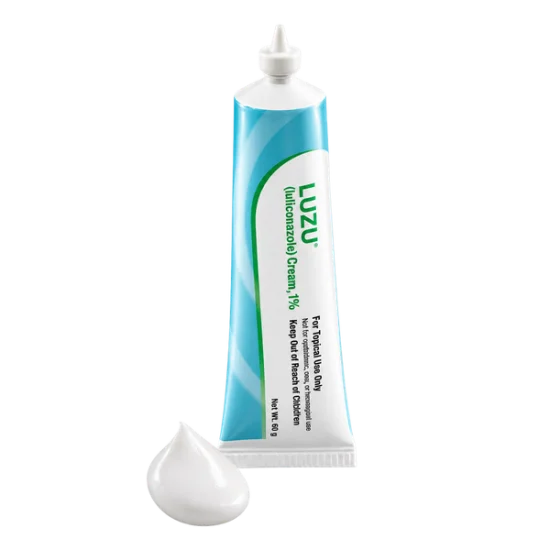
Luzu
Active ingredient: Luliconazole
Delivery: from 4 days
- Only original products
- Worldwide Delivery
- 24/7 Support
Luliconazole blocks the fungal enzymes needed to build a protective cell membrane, and Luzu cream delivers this antifungal action directly to affected skin. It is used for ringworm infections such as athlete’s foot, jock itch, and body ringworm, helping reduce scaling, redness, and itching.
Product information
Luzu is a topical antifungal cream containing luliconazole 1%. Luliconazole belongs to the imidazole class of antifungal medicines. It is applied to the skin for dermatophyte infections, including tinea pedis, tinea cruris, and tinea corporis.
Therapeutic indications
Luzu cream is used for dermatophyte infections of the skin. The principal clinical conditions include:
- Tinea pedis: athlete’s foot, usually affecting the spaces between the toes or the soles.
- Tinea cruris: jock itch involving the groin and adjacent skin.
- Tinea corporis: ringworm affecting the trunk, limbs, or other exposed skin.
- Pruritus associated with fungal infection: itching caused by the underlying dermatophyte infection.
A circular rash is common in tinea corporis, but fungal infections do not always form a perfect ring. Athlete’s foot may appear as peeling between the toes, while groin infection often causes an itchy, spreading border.
Luzu is not intended to treat every itchy rash. Eczema, contact dermatitis, psoriasis, rosacea, and bacterial skin infections require different approaches. A rash that becomes painful, produces pus, forms blisters, or spreads rapidly needs clinical assessment rather than repeated self-treatment.
| Condition | Typical pattern | Treatment focus |
|---|---|---|
| Tinea pedis | Scaling, cracking, or itch on the feet | Treat affected skin and keep feet dry |
| Tinea cruris | Itchy rash in the groin or inner thighs | Apply to involved external skin |
| Tinea corporis | Expanding scaly patch on the body | Treat the lesion and surrounding margin |
How it affects the body
Fungal cells need ergosterol to maintain their cell membrane. Luliconazole inhibits lanosterol 14α-demethylase, an enzyme involved in ergosterol production. This creates abnormal sterol levels inside the fungus and damages the membrane structure required for growth.
The medicine acts against dermatophytes that cause common superficial infections. These organisms can affect the feet, groin, trunk, and other areas of keratinised skin. As fungal activity declines, scaling and itch generally improve.
The effect is local rather than immune-suppressing. This makes the medicine pharmacologically different from a topical corticosteroid, which reduces inflammation but does not treat the fungal organism itself. A steroid may temporarily reduce redness while allowing a fungal infection to persist or spread.
Luliconazole is also active against certain yeasts in laboratory testing, although the approved use of a specific product depends on its regulatory indication. The WHO describes dermatophyte infections as superficial fungal diseases involving skin, hair, or nails, with treatment selected according to the affected site and organism [2]. Related patient guidance is also available from the Centers for Disease Control and Prevention (CDC) and the American Academy of Dermatology (AAD).
Cellular Target and Skin Response
Luliconazole reaches the outer layers of the skin after topical application. Its antifungal activity reduces the fungal burden within the treated area. It does not provide instant anaesthesia, so itching may not disappear after the first application.
Some symptoms improve before the infection has fully cleared. The visible redness may fade while small amounts of scaling remain. Completing the prescribed course helps reduce the chance of incomplete treatment.
When not to use it
Luzu is not suitable for people with a known allergy to luliconazole or any component of the cream. It should also not be used casually on an undiagnosed rash, because several inflammatory and infectious conditions resemble ringworm.
Pregnancy and breastfeeding require an individual assessment of the treatment area, duration, and expected benefit.
Luliconazole has low systemic absorption when applied topically, though absorption can increase when large areas, damaged skin, or occlusive coverings are involved. Apply only to the affected external skin and avoid prolonged unsupervised use.
When this is not for you
This medication is not for you if:
- You have previously had an allergic reaction to luliconazole.
- The rash is near or inside the eyes.
- The affected area is inside the mouth, nose, vagina, or another mucosal site.
- You suspect a severe bacterial infection with pus, spreading warmth, or significant pain.
- The lesion is rapidly expanding, blistered, ulcerated, or associated with fever.
- The problem involves the scalp or nails, where topical treatment alone may be inadequate.
- You plan to cover the area with an airtight dressing without clinical direction.
Children require age-appropriate use. The FDA label includes treatment indications for children from two years of age for some body and groin infections, while athlete’s foot use has a higher labelled age threshold .
Possible side effects
The most common reactions are local and temporary. The FDA label reports application-site reactions such as irritation, redness, itching, or burning in some users .
Possible effects include:
- Burning or stinging after application.
- Mild redness or dryness.
- Itching at the application site.
- Irritant contact dermatitis.
- Allergic contact dermatitis.
- Swelling or worsening discomfort.
A mild brief sting can occur on cracked or inflamed skin. Persistent burning, marked swelling, blistering, or a spreading rash suggests intolerance or another skin problem.
Unlike corticosteroid creams, luliconazole does not cause steroid-related skin thinning, telangiectasia, or striae through its antifungal mechanism. Those complications are associated with prolonged topical corticosteroid exposure, not with luliconazole itself.
A fungal rash may also appear to worsen during treatment because the skin remains inflamed after fungal growth begins to decline. Lack of improvement, rapid spread, or involvement of the nails or scalp calls for a reassessment of the diagnosis.
Ingredients
Luzu is a topical antifungal cream containing luliconazole 1%. Luliconazole belongs to the imidazole class of antifungal medicines. It is applied to the skin for dermatophyte infections, including tinea pedis, tinea cruris, and tinea corporis.
The cream is designed for local treatment. Compared with an oral antifungal, topical luliconazole exposes the affected skin directly while producing limited systemic exposure when used as directed. The FDA prescribing information supports its use for dermatophyte infections in adults and selected paediatric age groups [1].
Active Ingredient and Concentration
The active ingredient is luliconazole 1% in a cream formulation. It interferes with fungal sterol production, weakening the fungal cell membrane and stopping further growth.
Luliconazole is intended for external use. It should not be placed in the eyes, mouth, vagina, or other internal body sites.
Dosage and administration
Use Luzu on clean, dry skin. The amount and frequency depend on the purpose of use and are agreed with a doctor or pharmacist.
- Apply a thin layer to the affected skin.
- Extend the application slightly beyond the visible edge of the rash.
- Wash hands before and after application unless the hands are the treatment site.
- Use the cream only on external skin.
- Avoid covering the area with airtight or occlusive dressings unless specifically directed.
- Continue for the prescribed duration, even if itching improves early.
- Do not apply extra cream to compensate for a missed application.
- If an application is missed, apply it when remembered unless the next scheduled application is close.
For tinea cruris and tinea corporis, the FDA-approved regimen is once daily for one week in adults and appropriate paediatric patients. For tinea pedis, the approved course is once daily for two weeks in adults and adolescents within the labelled age range .
Do not apply the cream more frequently than directed. More cream does not clear the infection faster and may increase irritation.
Practical Application Technique
A thin film is sufficient. Rubbing forcefully can aggravate inflamed skin and create tiny cracks. Gentle spreading is enough to distribute the cream.
Avoid applying Luzu immediately after shaving irritated skin. Wait until the skin has settled, because shaving-related micro-abrasions can increase stinging.
Do not use the cream inside the ear canal or on mucosal tissue. If accidental contact occurs with the eyes, rinse with clean water.
Comparison
Luzu uses luliconazole as a single active antifungal. Other topical approaches use different antifungal classes or combine an antifungal with an anti-inflammatory ingredient.
| Approach | Main pharmacological role | Practical limitation |
|---|---|---|
| Luliconazole cream | Inhibits fungal sterol production | Requires consistent application to the affected area |
| Allylamine antifungal | Blocks a different step in ergosterol synthesis | Suitability depends on the infection site and diagnosis |
| Antifungal–steroid combination | Reduces inflammation while treating fungi | Steroid exposure may worsen or mask an infection if used inappropriately |
Luliconazole may be selected when a clinician wants a focused topical antifungal treatment. Combination products can reduce redness quickly, yet the steroid component may hide ongoing fungal activity. The choice depends on the appearance, location, duration, and severity of the skin problem.
Common mistakes
Several habits can reduce the chance of a good result:
- Stopping as soon as the itch decreases.
- Applying the cream only to the centre of a circular rash.
- Using a thick layer and assuming more product means faster clearance.
- Covering the area tightly with plastic or airtight material.
- Applying the cream to the wrong diagnosis, such as eczema or psoriasis.
- Using a steroid cream alone on a suspected fungal rash.
- Sharing towels, shoes, socks, or sports clothing.
- Ignoring persistent foot infection while treating a groin rash.
- Applying the cream to the eyes, mouth, or genital mucosa.
- Treating a scalp or nail infection with skin cream alone.
Do not use old cream left over from a previous rash for a new lesion without identifying the cause. Similar-looking eruptions can have completely different treatments.
What doctors say
In clinical practice, doctors often look first at the border of a rash, the amount of scaling, the location, and whether similar symptoms affect household contacts. A circular rash is suggestive, but appearance alone cannot confirm a fungal infection.
A clinician would usually expect itching and surface scaling to improve before the skin colour returns to normal. Residual pink or brown discoloration can remain after the organism has been controlled. That colour change does not always mean treatment failure.
One practical issue is incomplete application. Patients often treat the centre of a ring-shaped lesion and leave the active edge untouched. Applying a thin layer across the lesion and just beyond its border gives the medicine better coverage.
Another frequent problem is reinfection from damp footwear, shared towels, or untreated athlete’s foot elsewhere on the body. Foot infection can act as a continuing source for groin or body lesions.
Common questions
Can I go into the sun while using Luzu?
Routine sun exposure is not listed as a specific contraindication for topical luliconazole in the FDA prescribing information from 2013. The treated skin may still be more sensitive if it is inflamed, cracked, or irritated. Cover the area with clothing when practical and avoid tanning the affected skin while it heals. Severe redness after sunlight is not a typical treatment goal and should prompt reassessment . Persistent sensitivity or a changing rash warrants medical advice.
What should I do if the expected result does not come?
The FDA label from 2013 supports a defined course for the approved fungal infections, but persistent symptoms after treatment can indicate an incorrect diagnosis, reinfection, or an infection involving a site that needs a different approach. Do not keep extending the course or apply the cream more often without medical direction. A clinician may examine the skin or arrange testing when the appearance is unclear. Nail, scalp, recurrent, or widespread disease may need treatment beyond a topical cream.
How long does one application keep working?
The approved regimens described by the FDA in 2013 use once-daily application, which means the treatment plan is designed around one application per day rather than repeated use throughout the day. Do not add extra applications after sweating, bathing, or mild rubbing unless instructed. If the cream is washed off soon after application, ask a pharmacist or doctor whether it should be reapplied. The length of antifungal activity does not mean the infection is cured after a single dose.
Which symptoms mean I should stop and seek urgent medical help?
The FDA label from 2013 identifies hypersensitivity and local application-site reactions as relevant safety concerns. Stop using the cream and seek urgent care for facial swelling, difficulty breathing, widespread hives, faintness, or swelling of the lips or tongue. Prompt medical assessment is also needed for rapidly spreading redness with fever, severe pain, pus, or red streaks. These features can indicate a serious allergic reaction or a bacterial infection requiring different treatment.
Can Luzu cause burning or stinging?
Mild application-site burning or stinging is described in the FDA prescribing information from 2013 and may occur when the cream touches irritated or cracked skin. A brief, mild sensation can settle, but increasing pain, blistering, marked swelling, or intense redness is different. Stop further applications if those symptoms develop and obtain medical advice. Do not cover the area tightly to try to make the medicine work faster.
Do you offer anonymous delivery?
Your order will be securely packed and shipped within 24 hours. This is exactly what your package will look like (images of an actual item sent). It has the size and look of a regular private letter (24x11x0.7 cm) and its contents cannot be seen.
Comparison
How Buyers Rate Luzu
-
Bilal, 62 Khalifa City · The prescribed course 25 Oct 2026Rating: 4.5 out of 5Khalifa City, used Luzu once daily for the prescribed course. The itching between his toes eased within several days, and the scaling had settled by the end. He was satisfied that the cream was easy to spread and did not leave a heavy residue.
-
Hassan F., 37 Al Majaz · The first week 3 Nov 2026Rating: 5 out of 5Al Majaz, applied Luzu to a body rash each evening. The raised edge became less noticeable during the first week, and the area looked much clearer after completing treatment. He found the tube convenient for keeping in a bathroom cabinet.
-
Anil, 34 Mirdif · The first applications 8 Nov 2026Rating: 3 out of 5Mirdif, used the cream for an itchy groin rash. It helped, but the improvement was slower than expected and there was mild stinging during the first applications. He also had to change his gym towel routine because the rash kept returning when damp clothing was reused.
-
Karim V., 69 Ajman · The course 14 Nov 2026Rating: 3 out of 5Ajman, applied Luzu to a foot infection and saw less scaling, although a small area remained after the course. The persistent patch led him to speak with a doctor rather than continuing the cream indefinitely. He felt the treatment helped the original itch but did not resolve every skin change.
-
Khalid, 63 Ruwais · During treatment 20 Nov 2026Rating: 4 out of 5Ruwais, used Luzu for ringworm on the body and noticed the border became flatter and less itchy during treatment. He completed the course and was pleased with the result. The remaining darker skin colour faded more slowly than the active rash.
Sources
- U.S. Food and Drug Administration (2013). Luzu (luliconazole) Cream, 1% Prescribing Information.
- World Health Organization (2021). WHO Guidelines for the Diagnosis, Prevention and Management of Skin-Related Neglected Tropical Diseases.
