
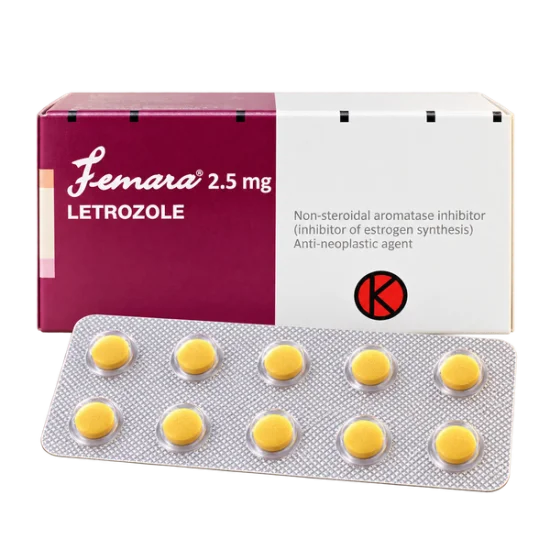
Femara
Active ingredient: Letrozole
Delivery: from 4 days
- Only original products
- Worldwide Delivery
- 24/7 Support
Femara lowers estrogen production by blocking aromatase, an enzyme that helps the body make estrogen. Its active ingredient, letrozole, is an oral aromatase inhibitor prescribed mainly for postmenopausal women with hormone receptor-positive breast cancer. Reduced estrogen can slow the growth of estrogen-sensitive tumour cells.
Product information
Femara contains letrozole, a non-steroidal aromatase inhibitor supplied as oral tablets. Letrozole targets aromatase, the enzyme responsible for converting adrenal hormones into estrogen in tissues such as fat and muscle. After menopause, the ovaries produce far less estrogen, so this peripheral pathway becomes clinically significant.
Active Ingredient and Drug Class
Letrozole belongs to the non-steroidal aromatase inhibitor class. The individual dose is decided by the treating oncology team, taking age, other medicines, and health conditions into account. Aromatase inhibitors differ from tamoxifen. Letrozole reduces estrogen production, while tamoxifen mainly blocks estrogen receptors in breast tissue.
Therapeutic indications
Femara is prescribed for postmenopausal women in several breast cancer settings. The precise treatment plan depends on tumour receptor status, stage, previous surgery, chemotherapy, radiotherapy, and the oncology team’s assessment.
Common clinical indications include:
- Adjuvant treatment after surgery for hormone receptor-positive early breast cancer.
- Extended endocrine treatment after a previous course of tamoxifen.
- Initial endocrine treatment for hormone receptor-positive advanced breast cancer.
- Treatment of advanced breast cancer after progression during anti-estrogen therapy.
- Treatment after disease progression while receiving tamoxifen.
“Adjuvant” means treatment given after the main cancer treatment to reduce the chance of recurrence. “Advanced” breast cancer refers to disease that has spread locally or to distant organs and requires systemic treatment.
Femara is most useful when the cancer is hormone receptor-positive. A receptor test performed on tumour tissue helps determine whether endocrine treatment is appropriate. Estrogen receptor status and progesterone receptor status are interpreted alongside tumour stage and other pathology findings.
The European Medicines Agency describes letrozole as an endocrine treatment for postmenopausal women with hormone-sensitive breast cancer [2].
Off-Label Ovulation Induction and Infertility
Letrozole is also used off-label in reproductive endocrinology to induce ovulation, especially in women who do not ovulate regularly, including some women with polycystic ovary syndrome. This use is distinct from Femara’s approved oncology indications.
In ovulation induction, letrozole temporarily lowers estrogen early in the menstrual cycle. The pituitary gland may respond by increasing follicle-stimulating hormone, or FSH. FSH stimulates follicular development, which can lead to ovulation.
This treatment requires cycle timing and clinical monitoring. Ultrasound assessment, ovulation testing, or hormone measurements may be used according to the fertility plan. The aim is to support development of a mature follicle while limiting the risk of excessive ovarian stimulation.
Letrozole and clomiphene act through different endocrine patterns. Clomiphene blocks estrogen feedback at the hypothalamus and pituitary, while letrozole reduces estrogen synthesis for a shorter period. Letrozole may be selected in some anovulatory patients, but treatment choice depends on age, ovarian reserve, body weight, semen analysis, tubal status, and previous treatment.
How it affects the body
Aromatase normally converts androgens into estrogen. Letrozole inhibits this conversion, producing marked estrogen suppression in postmenopausal women. Lower estrogen removes a growth signal from hormone receptor-positive tumour cells. The FDA prescribing information describes this mechanism and its role in adjuvant and advanced breast cancer treatment [1].
When not to use it
Femara is not appropriate for everyone.
- You are pregnant or could be pregnant without an appropriate pregnancy assessment.
- You are breastfeeding.
- You have a known allergy to letrozole or a tablet ingredient.
- You are premenopausal and are taking it for breast cancer without appropriate ovarian function suppression.
- You have severe liver disease requiring specialist treatment planning.
- You are using it for fertility treatment without cycle monitoring and pregnancy testing.
Letrozole can interact with medicines that affect liver enzymes. Tamoxifen may reduce letrozole exposure, so the two should not be combined or alternated without a specialist plan.
When this is not for you
Femara may not be suitable if you are pregnant, breastfeeding, allergic to letrozole, or have not gone through menopause unless a specialist has arranged ovarian function suppression. It may also be unsuitable if you have severe liver disease or are using it for fertility treatment without medical monitoring. Tell your doctor about tamoxifen, other medicines, supplements, osteoporosis, previous fractures, liver disease, high cholesterol, or cardiovascular disease before treatment.
Possible side effects
Lowering estrogen can affect bones, joints, muscles, temperature regulation, mood, and sexual health. Side effects vary between patients. Some are mild and manageable; others require monitoring or a change in treatment.
| Reaction | Clinical pattern | Practical management |
|---|---|---|
| Hot flashes and sweating | Sudden warmth, flushing, or night sweats | Light clothing, a cooler bedroom, and discussion of persistent symptoms |
| Joint or muscle pain | Morning stiffness, aching hands, knees, hips, or shoulders | Movement, physiotherapy, and clinician-guided pain treatment |
| Bone loss | Reduced bone mineral density over time | Baseline and follow-up bone-density assessment when indicated |
| Fatigue | Reduced energy or poorer exercise tolerance | Pacing, sleep routine, nutrition, and assessment for anaemia or other causes |
| Hair thinning or hair loss | Usually diffuse rather than patchy | Gentle hair care and review if severe |
| Nausea or indigestion | More likely near treatment initiation | Smaller meals and prescribed symptom treatment if needed |
Aromatase inhibitor treatment can reduce bone mineral density and increase fracture risk. Doctors may assess fracture risk, vitamin D status, calcium intake, falls risk, and the need for bone-protective treatment. Bone-density scanning is often used when the clinical risk warrants it.
Femara can also cause headache, dizziness, ankle swelling, increased cholesterol, vaginal dryness, sleep disturbance, and mood changes. A new symptom may have another cause, so persistent fatigue or pain should not automatically be attributed to letrozole.
Urgent medical attention is needed for chest pain, sudden breathlessness, one-sided weakness, severe allergic swelling, fainting, severe abdominal pain, or a painful swollen leg. These symptoms can signal a serious condition that needs prompt assessment.
Ingredients
Femara contains letrozole, a non-steroidal aromatase inhibitor supplied as oral tablets.
Active Ingredient and Drug Class
Letrozole belongs to the non-steroidal aromatase inhibitor class. The individual dose is decided by the treating oncology team, taking age, other medicines, and health conditions into account.
Dosage and administration
- Take Femara tablets by mouth according to the individualized treatment plan set by the oncology team.
- Take the tablets at the prescribed frequency and time of day.
- Continue treatment for the duration determined by the oncology team.
- Do not change the dose or treatment schedule without medical guidance.
Comparison
Femara is a brand name for letrozole. A generic letrozole product contains the same active pharmaceutical ingredient and is designed to meet regulatory requirements for pharmaceutical quality and bioequivalence.
| Feature | Femara | Generic letrozole |
|---|---|---|
| Active ingredient | Letrozole | Letrozole |
| Drug class | Non-steroidal aromatase inhibitor | Non-steroidal aromatase inhibitor |
| Possible difference | Tablet excipients, colour, shape, or packaging | Excipients and tablet appearance may differ |
Bioequivalence means that the active ingredient reaches the body in a comparable amount and over a comparable time under approved testing conditions. Excipients can differ and may affect tolerability in someone with a known sensitivity. Potential advantages of letrozole include oral once-daily dosing, use across several hormone receptor-positive breast cancer settings, and availability as a generic option. A drawback is that estrogen suppression can cause joint symptoms and bone loss, so treatment may require monitoring and supportive care.
Switching between products should follow the prescribing plan. Duplicate use of Femara and another letrozole tablet would increase exposure and does not improve treatment.
Aromatase Inhibitors and Alternative Antineoplastic Agents
Endocrine therapy is selected according to menopausal status, receptor results, tumour stage, prior treatment, side-effect risk, and drug interactions. The following medicines are pharmacologically related but are not interchangeable without an oncology decision.
| Treatment | Main class and action | Clinical distinction |
|---|---|---|
| Letrozole, anastrozole | Non-steroidal aromatase inhibitors that reduce estrogen synthesis | Common options for postmenopausal hormone receptor-positive disease |
| Exemestane | Steroidal aromatase inhibitor that permanently inactivates aromatase | May be used after prior endocrine therapy or when a different inhibitor is preferred |
| Tamoxifen | Selective estrogen receptor modulator | Blocks estrogen signalling in breast tissue and has a different clotting and uterine risk profile |
Anastrozole is the active ingredient in Arimidex. Exemestane is the active ingredient in Aromasin. Fulvestrant, marketed as Faslodex, binds and degrades the estrogen receptor rather than inhibiting aromatase.
Palbociclib, abemaciclib, and ribociclib are CDK4/6 inhibitors. They may be combined with endocrine treatment in selected advanced or high-risk breast cancer settings. They work through cell-cycle control rather than directly lowering estrogen production.
Postmenopausal women often receive an aromatase inhibitor as part of endocrine therapy. Premenopausal women may need ovarian function suppression before an aromatase inhibitor can provide the intended endocrine effect. Tamoxifen can be used in different menopausal settings, though its benefits and risks differ from those of letrozole.
Common mistakes
Several everyday mistakes can reduce treatment reliability or delay care:
- Taking two tablets after forgetting one dose.
- Stopping treatment abruptly because joint pain appears without discussing alternatives.
- Assuming that a missed dose should be replaced at bedtime.
- Using Femara with tamoxifen without a documented oncology plan.
- Continuing treatment after a positive pregnancy test.
- Treating new chest pain or breathlessness as a routine side effect.
- Skipping dental and bone-health discussions despite fracture risk.
- Starting calcium, vitamin D, or herbal supplements without reviewing the full medicine list.
- Taking Femara for fertility without confirming ovulation timing and pregnancy status.
- Assuming that a different tablet appearance means the active ingredient has changed.
If a dose is missed, the usual approach is to take it when remembered unless the next scheduled dose is near. Taking extra tablets to compensate is not appropriate. The individual dosing plan remains the deciding factor when treatment timing is complex.
What doctors say
In oncology practice, doctors usually set expectations early: Femara is a long-term endocrine treatment, and benefit is measured over months and years rather than by a noticeable daily sensation. The absence of symptoms does not mean the medicine is inactive, and the presence of joint pain does not automatically mean treatment must stop.
A common clinical problem is silent bone loss. Patients may feel well while bone mineral density gradually declines, which is why fracture-risk assessment can matter even when there is no pain.
Another practical point concerns treatment persistence. Stopping letrozole repeatedly because of stiffness can reduce the intended endocrine benefit. Clinicians may consider exercise therapy, symptom treatment, a supervised switch to another endocrine option, or bone protection instead of assuming that every patient must simply tolerate severe symptoms.
The British National Institute for Health and Care Excellence includes endocrine therapy, receptor status, menopausal status, and recurrence risk in breast cancer treatment decisions [3]. The American Society of Clinical Oncology also discusses endocrine therapy selection according to menopausal status and tumour biology.
Common questions
How long does a Femara course last, and is long-term use acceptable?
The duration depends on cancer stage, recurrence risk, menopausal status, previous tamoxifen, and treatment response. In breast cancer care, endocrine treatment commonly continues for several years when the expected benefit remains greater than the risks. The FDA Femara prescribing information reviewed in 2020 describes both adjuvant and advanced-disease treatment plans, while the EMA SmPC describes treatment duration according to clinical setting. Long-term use requires attention to bone density, fractures, cholesterol, joint symptoms, and adherence. The treatment plan should be reviewed regularly as risks and benefits change.
Can Femara be combined with medicines or supplements for bone health?
Calcium and vitamin D may be considered when dietary intake or laboratory results indicate a need, but supplementation should fit the individual bone-health plan. Bisphosphonates and other bone-protective medicines may be prescribed for selected patients at elevated fracture risk. The EMA’s 2023 letrozole product information supports monitoring clinical factors affected by estrogen deprivation. Supplements can interact with other medicines or be unsuitable in kidney disease, so the complete medicine list should be reviewed before adding them.
How long does one Femara tablet keep working?
Letrozole has a prolonged pharmacological effect because aromatase inhibition continues beyond the time the tablet is swallowed. A once-daily regimen maintains the intended suppression when taken consistently. The FDA’s 2020 prescribing information describes daily administration rather than repeated dosing through the day. A single tablet should not be repeated because the patient cannot feel the degree of estrogen suppression directly.
Can Femara affect driving, concentration, or work with machinery?
Femara can cause dizziness, fatigue, sleep disturbance, or difficulty concentrating in some patients. These effects may be more noticeable when treatment begins or when another medicine is added. The EMA’s 2023 product information advises caution with activities requiring alertness when such symptoms occur. Driving or machinery work should wait until the individual response is clear if dizziness or impaired concentration develops.
Which symptoms mean stopping Femara and seeking urgent medical care?
Urgent assessment is needed for sudden breathlessness, chest pain, fainting, severe allergic swelling, one-sided weakness, or a painful swollen leg. These symptoms can indicate a serious cardiovascular, allergic, neurological, or clot-related problem rather than a routine treatment effect. The FDA’s 2020 safety information supports prompt evaluation of serious or rapidly worsening symptoms. Do not take an extra tablet while waiting for medical assessment.
Can Femara be used during pregnancy or breastfeeding?
Femara should not be used during pregnancy, and breastfeeding is not compatible with treatment. Letrozole can interfere with estrogen production and may harm fetal development. The WHO’s 2019 medication-safety principles require pregnancy and lactation exposure to be assessed separately because fetal and infant risks are different. Women who could become pregnant need an appropriate contraception and pregnancy-testing plan.
Which condition rules Femara out completely?
A confirmed pregnancy rules Femara out for routine use. A known allergy to letrozole or a tablet ingredient is another clear contraindication. The EMA SmPC from 2023 lists pregnancy, lactation, and hypersensitivity among the key restrictions. Premenopausal breast cancer also requires specialist endocrine planning because an aromatase inhibitor alone may not provide the intended ovarian suppression.
Do you offer anonymous delivery?
Your order will be securely packed and shipped within 24 hours. This is exactly what your package will look like (images of an actual item sent). It has the size and look of a regular private letter (24x11x0.7 cm) and its contents cannot be seen.
Comparison



How Buyers Rate Femara
-
Rachel, 55 Deira · Several weeks 16 Nov 2026Rating: 4.5 out of 5I took Femara after my breast cancer surgery and kept it with my morning routine. After several weeks, I felt more confident about staying consistent because the tablets fitted easily into the day.
-
Lina, 40 Dibba Al-Fujairah · A monitored fertility cycle 22 Nov 2026Rating: 5 out of 5I used letrozole as part of a monitored fertility cycle. The timing was clear, and the treatment gave me a definite ovulation plan rather than leaving me guessing.
-
Salma, 61 Dubai · The first months 26 Oct 2026Rating: 3 out of 5Femara helped with my cancer treatment, but the stiffness in my hands was frustrating during the first months. I discussed it with my doctor, adjusted my morning movement routine, and still felt the treatment was worthwhile.
-
Shamma, 43 Al Ain 5 Nov 2026Rating: 5 out of 5I used letrozole under fertility supervision and appreciated having a simple tablet schedule. It took patience, but the cycle monitoring made the process feel organised.
Sources
- U.S. Food and Drug Administration (2020). Femara (letrozole) prescribing information.
- European Medicines Agency (2023). Summary of Product Characteristics (SmPC) — letrozole.
- National Institute for Health and Care Excellence (2023). Early and locally advanced breast cancer: diagnosis and management.
