
- Only original products
- Worldwide Delivery
- 24/7 Support
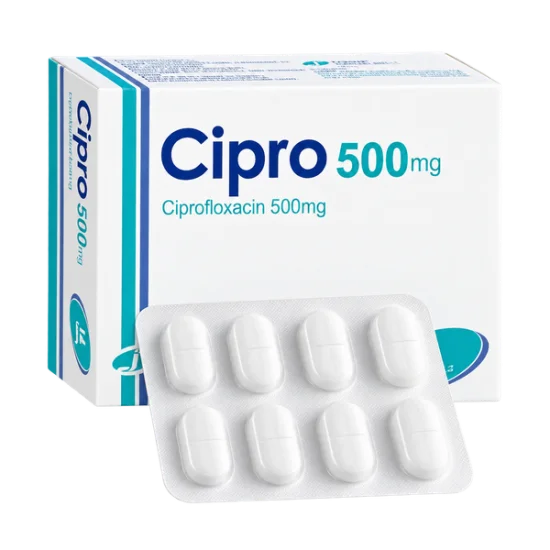
Cipro is used for selected bacterial infections, including urinary tract infections and other infections caused by susceptible organisms. Cipro contains ciprofloxacin and is prescribed for specific bacterial infections when the suspected organism is susceptible to it.
Product information
It contains ciprofloxacin, a fluoroquinolone antibiotic that blocks bacterial DNA replication and helps stop the spread of infection.
Ciprofloxacin belongs to the fluoroquinolone class, which is part of the broader quinolone family.
Therapeutic indications
Cipro contains ciprofloxacin and is prescribed for specific bacterial infections when the suspected organism is susceptible to it. The 500 mg tablet is an oral form used in adults for conditions such as complicated urinary tract infections, selected gastrointestinal infections, typhoid fever, and post-exposure management of inhalational anthrax. Ciprofloxacin is also active against several Gram-negative organisms, including some strains of E. coli and Campylobacter jejuni.[3]
The choice of Cipro depends on the infection site, bacterial susceptibility, kidney function, age, previous antibiotic exposure, and other medicines. Acute uncomplicated cystitis may require a different first-choice antibiotic because fluoroquinolones are reserved for situations where their expected benefit justifies their risks.
| Clinical situation | Typical role of ciprofloxacin |
|---|---|
| Complicated urinary infection | Treatment when the causative organism is susceptible |
| Selected gastrointestinal infections | Use against susceptible Gram-negative bacteria |
| Anthrax exposure | Specialist-directed post-exposure treatment |
| Typhoid fever | Treatment when laboratory susceptibility supports its use |
Cipro does not treat viral illnesses such as influenza, most sore throats caused by viruses, or ordinary viral coughs. Antibiotics cannot shorten those infections.
Target Pathogens and Susceptibility Spectrum
Ciprofloxacin has strong activity against many Gram-negative bacteria. Susceptible E. coli strains are a common reason for its use in urinary infections. Activity against Campylobacter jejuni and other organisms varies by region and resistance pattern, so laboratory testing may guide treatment.
Gonorrhoea requires special care. Resistance to fluoroquinolones is widespread in many regions, which means ciprofloxacin should only be used when susceptibility has been established through an appropriate test. The same principle applies to typhoid fever and complicated urinary infections.
Cipro requires a prescription because the wrong antibiotic can delay recovery, promote resistance, or expose the patient to avoidable adverse reactions.
How it affects the body
It acts as a bactericidal antibiotic by interfering with enzymes that bacteria need to copy and repair their DNA.
The two main targets are DNA gyrase, also called bacterial topoisomerase II, and topoisomerase IV. DNA gyrase helps control tension in bacterial DNA during replication. Topoisomerase IV helps separate newly copied DNA strands. Ciprofloxacin inhibits both processes, causing lethal damage in susceptible bacterial cells.[1]
Human cells use different enzymes, so ciprofloxacin can target bacterial replication more selectively than human DNA synthesis.
When not to use it
This medicine is not for you if you have had a serious allergic reaction to ciprofloxacin, another quinolone, or a related fluoroquinolone. It is also contraindicated with tizanidine because ciprofloxacin can markedly raise tizanidine exposure and cause profound drowsiness, low blood pressure, and impaired movement.
Use requires careful clinical assessment in the following situations:
- Myasthenia gravis, because fluoroquinolones can worsen neuromuscular weakness
- Previous tendon disorder linked to a quinolone
- A history of peripheral neuropathy
- Seizure disorders or conditions that lower the seizure threshold
- Significant kidney impairment
- Aortic aneurysm or risk factors for aortic disease
- Heart rhythm disorders or medicines that prolong the QT interval
- Pregnancy, breastfeeding, or planned conception
- Diabetes treated with insulin or oral glucose-lowering medicines
- Known severe liver disease
When this is not for you
Cipro should not be used for a mild infection simply because it is a powerful antibiotic. The potential harm may exceed the likely benefit when a narrower option is suitable.
Children and adolescents generally receive ciprofloxacin only for specific indications where specialist judgment supports its use, because developing joints and tendons require additional consideration.
Possible side effects
Cipro can cause mild reactions, yet it also carries serious fluoroquinolone warnings. The FDA prescribing information describes risks involving tendons, nerves, muscles, joints, the central nervous system, and the cardiovascular system.[2]
Common or relatively frequent reactions may include:
- Nausea, diarrhoea, stomach discomfort, or vomiting
- Headache, dizziness, or restlessness
- Sleep disturbance
- Changes in taste
- Mild skin rash or itching
- Temporary changes in blood glucose
Severe diarrhoea needs assessment. It can indicate Clostridioides difficile infection. This illness may cause watery diarrhoea, abdominal cramping, fever, and dehydration. It requires medical assessment rather than self-treatment with anti-diarrhoeal products.
Tendon Injury
Tendinitis and tendon rupture are important fluoroquinolone risks. The Achilles tendon is commonly affected, although tendons in the shoulder, hand, or other areas can also be involved. The risk increases in older adults, people with kidney disease, transplant recipients, and patients taking systemic corticosteroids.
Stop strenuous exercise and obtain urgent medical assessment if tendon pain, swelling, stiffness, or a sudden snapping sensation develops. Tendon symptoms can begin during treatment or after the course has finished.
Peripheral Neuropathy and Nervous-System Effects
Peripheral neuropathy may cause burning, tingling, numbness, altered sensation, or weakness in the arms or legs. Some symptoms can persist after the antibiotic is stopped. Anxiety, confusion, tremor, hallucinations, seizures, or severe insomnia also require prompt clinical attention.
One practical detail is easy to miss: a new burning or electric sensation in the feet is not an ordinary sign that the infection is clearing. It can represent nerve irritation and should be reported quickly.
Cardiac and Glucose-Related Effects
Ciprofloxacin can prolong the QT interval in people with relevant risk factors. The risk is higher with congenital long-QT syndrome, low potassium or magnesium, significant bradycardia, heart disease, or concurrent QT-prolonging medicines. Fainting or a rapid irregular heartbeat needs urgent evaluation.
People with diabetes may experience changes in blood glucose, including hypoglycaemia or hyperglycaemia. Extra monitoring is sensible when ciprofloxacin is prescribed with insulin or glucose-lowering medicines.
Ingredients
Cipro tablets contain ciprofloxacin, a fluoroquinolone antibiotic that blocks bacterial DNA replication and helps stop the spread of susceptible bacterial infections. The dose is determined individually, taking age, other medicines, and health conditions into account.
Dosage and administration
- Dose: the individual dose is determined according to the infection, age, other medicines, kidney function, and other health factors.
- Frequency: take it at the times and number of times per day prescribed for the specific infection.
- Timing: take the tablet with a full glass of water; do not take it at the same time as calcium, magnesium, aluminium, iron, or zinc supplements.
- Duration: use it for the prescribed treatment duration; do not double a dose if one is missed.
- Route: swallow the tablet orally.
- Missed dose: take it when remembered unless the next scheduled dose is near.
- Vomiting: if vomiting occurs soon after swallowing the tablet, confirm the appropriate next step with the prescribing service.
Comparison
Cipro should be compared with alternatives by active ingredient, infection site, resistance pattern, kidney handling, and adverse-effect profile. It is not interchangeable with every fluoroquinolone or with every antibiotic used for urinary infection.
| Treatment category | Main distinction |
|---|---|
| Ciprofloxacin | Strong Gram-negative activity; important interaction and tendon warnings |
| Levofloxacin-type fluoroquinolone | Different tissue distribution and spectrum; similar class warnings |
| Trimethoprim/sulfamethoxazole or fosfomycin | Non-fluoroquinolone options used for selected urinary infections |
Trimethoprim/sulfamethoxazole may be suitable for some urinary infections when local resistance is low and the organism is susceptible. Fosfomycin is used for selected lower urinary infections and has a different mechanism. Neither option is automatically appropriate for every patient.
Other fluoroquinolones, including ofloxacin and moxifloxacin, have different pharmacokinetic properties and coverage patterns. Moxifloxacin is not a routine choice for urinary infections because urinary concentrations are less suitable for that purpose. Choice depends on microbiology rather than on the general strength of the antibiotic.
Older fluoroquinolones and certain medicines once used for similar infections are not interchangeable with Cipro. A prescriber considers culture results, allergy history, organ function, previous adverse reactions, and local antimicrobial-resistance data. WHO and the European Centre for Disease Prevention and Control (ECDC) stewardship principles support reserving broad-spectrum antibiotics for situations where their spectrum is clinically justified.[4]
Common mistakes
Several practical errors can reduce treatment success or increase adverse reactions:
- Taking Cipro together with iron, calcium, magnesium, zinc, or aluminium
- Stopping after the first improvement without a clinical reason
- Saving leftover tablets for a future infection
- Treating a viral cold or flu with an antibiotic
- Ignoring tendon pain, numbness, severe diarrhoea, or palpitations
- Exercising intensely despite new tendon symptoms
- Forgetting to mention corticosteroids, warfarin, theophylline, or tizanidine
- Taking a missed dose too close to the next scheduled dose
- Using anti-diarrhoeal products for severe watery diarrhoea without assessment
One overlooked mistake is drinking a mineral-fortified supplement at the same time as Cipro. The supplement may look unrelated, yet its calcium, magnesium, iron, or zinc can reduce antibiotic absorption.
What doctors say
In clinical practice, doctors usually reserve ciprofloxacin for infections where its Gram-negative activity is useful and the expected benefit outweighs class-specific risks. A physician will often ask about previous tendon problems, numbness, heart rhythm disease, kidney function, diabetes, and corticosteroid use before prescribing it.
A doctor may order cultures for recurrent urinary symptoms, fever, flank pain, hospital-acquired infection, or treatment failure. Persistent symptoms do not always mean that a stronger antibiotic is needed. They may indicate resistance, an abscess, obstruction, a non-bacterial condition, or an incorrect diagnosis.
MOHAP and EMA safety principles support careful fluoroquinolone prescribing, especially when a narrower antibiotic can treat the same infection. Patients should complete the prescribed course unless a serious reaction requires stopping and urgent medical assessment.
Common questions
What is the best time of day to take Cipro?
Cipro can be taken at a consistent time that fits the prescribed schedule, with water and without taking mineral products at the same time. FDA prescribing information available in 2023 describes the need to separate ciprofloxacin from aluminium, magnesium, calcium, iron, and zinc products. Taking it at the same times each day helps maintain steadier exposure.
Food does not remove the need to separate mineral supplements. A calcium-rich meal may also affect absorption, so the prescribing instructions should specify the required interval. Do not take Cipro with milk or yoghurt alone as the liquid used to swallow the tablet.
How does Cipro differ from the closest alternative by active substance?
Cipro contains ciprofloxacin, while alternative antibiotics may contain levofloxacin, trimethoprim with sulfamethoxazole, or fosfomycin. EMA safety guidance from 2018 treats fluoroquinolones as a distinct class with tendon, nerve, and nervous-system risks. The best option depends on the organism, infection site, resistance data, kidney function, and interaction profile.
Ciprofloxacin is often useful against susceptible Gram-negative bacteria. A different antibiotic may be preferred for uncomplicated cystitis or when fluoroquinolone risks are high. The active substance should be selected by clinical indication, not by brand familiarity.
Can the Cipro tablet be split, crushed, or chewed?
Cipro tablets should generally be swallowed with water rather than chewed or crushed. FDA product information from 2023 describes oral tablets as intended for swallowing, and altering a tablet can create an unpleasant taste or interfere with practical administration. A scored tablet should only be split when the prescribed product and instructions support splitting.
Do not substitute crushing for a swallowing problem without a pharmacist or prescriber confirming an appropriate formulation. Modified-release ciprofloxacin products require special care because their release pattern differs from immediate-release tablets. The 500 mg strength does not by itself determine whether splitting is suitable.
Which diet, exercise, or habits help or hinder treatment?
Water intake supports normal swallowing and helps avoid dehydration during an infection. WHO guidance from 2023 supports taking antibiotics only for bacterial conditions and avoiding unnecessary use. Mineral supplements, antacids, and fortified products can hinder ciprofloxacin absorption when taken too close to the tablet.
Avoid strenuous exercise if tendon pain or stiffness appears. Alcohol does not directly inactivate ciprofloxacin, yet it can worsen dizziness, dehydration, sleep disruption, or stomach upset. Regular sleep and taking doses at consistent times can make the course easier to complete.
What should happen if the expected result does not come?
Contact the prescribing service if symptoms worsen, fever persists, pain spreads to the back or flank, or there is no meaningful improvement within the expected clinical timeframe. MOHAP antibiotic-safety information in 2024 supports reassessment when treatment response is poor rather than adding another antibiotic independently. A culture, imaging study, or a change in diagnosis may be needed.
Seek urgent care for breathing difficulty, facial swelling, fainting, severe weakness, tendon rupture, confusion, or bloody diarrhoea. Persistent urinary symptoms may reflect resistance or obstruction. Do not use leftover Cipro to extend the course.
How long does one dose of Cipro keep working?
A single dose provides antibiotic exposure for part of the dosing interval, but it does not cure an infection by itself. FDA information from 2023 describes ciprofloxacin dosing as a scheduled course based on the infection and patient factors. The duration of antibacterial activity varies with kidney function, prescribed interval, and the organism involved.
Continue the course exactly as prescribed unless a serious reaction requires urgent review. Missing doses can reduce exposure and allow susceptible bacteria to persist. Taking extra tablets does not compensate safely for a missed dose.
Can Cipro be combined with corticosteroids or mineral supplements?
Cipro can interact with corticosteroids and mineral supplements in different ways. EMA safety communication from 2018 identifies corticosteroid use as a factor that increases tendon-injury risk with fluoroquinolones. Calcium, magnesium, iron, zinc, and aluminium can bind ciprofloxacin in the digestive tract and reduce absorption.
The combination is not automatically prohibited, but the timing and clinical need must be reviewed. Tizanidine is different: it is a contraindicated combination with ciprofloxacin. Warfarin, theophylline, cyclosporine, duloxetine, and medicines that prolong the QT interval also require specific review.
Do you offer anonymous delivery?
Your order will be securely packed and shipped within 24 hours. This is exactly what your package will look like (images of an actual item sent). It has the size and look of a regular private letter (24x11x0.7 cm) and its contents cannot be seen.
Comparison


How Buyers Rate Cipro
-
Tariq, 51 Ajman 25 Oct 2026Rating: 3 out of 5I took the 500 mg tablets for a urinary infection. The burning improved after a few days, but I noticed mild stomach upset and felt more tired than usual. I finished only after checking the symptoms with the doctor, and I avoided gym workouts when my ankle started feeling tight.
-
Hamza, 46 Al Khawaneej · Seven days 7 Nov 2026Rating: 5 out of 5Cipro helped clear a persistent infection after the culture showed that the bacteria was susceptible. The fever settled first, then the urinary symptoms eased over the next few days. Taking each tablet with water was easy.
-
James, 40 Al Nahda · Five days 14 Nov 2026Rating: 5 out of 5I used the prescribed course for a bacterial gastrointestinal infection. The cramps and frequent bathroom trips improved steadily, and I was back to normal activities by the end of treatment. I kept the tablets separate from my mineral supplement.
-
Hamdan T., 62 Al Majaz · Seven days 23 Nov 2026Rating: 5 out of 5The treatment worked for the infection I had been dealing with. I appreciated that the instructions covered my other medicines and kidney function before the course began. The symptoms improved without needing another antibiotic.
Sources
- U.S. Food and Drug Administration (2023). CIPRO (ciprofloxacin hydrochloride) tablets, prescribing information.
- U.S. Food and Drug Administration (2016). FDA updates warnings for fluoroquinolone antibiotics.
- World Health Organization (2022). The WHO AWaRe (Access, Watch, Reserve) antibiotic book.
- European Medicines Agency (2018). Quinolone- and fluoroquinolone-containing medicinal products: PRAC recommendations on disabling and potentially permanent side effects.
