
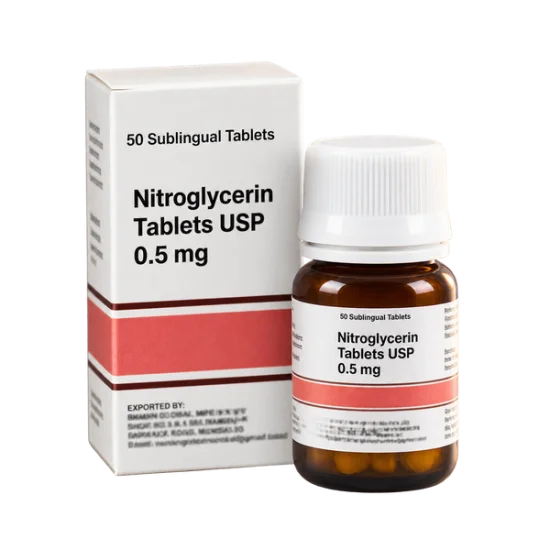
Nitroglycerin
Active ingredient: Nitroglycerin
Delivery: from 4 days
- Only original products
- Worldwide Delivery
- 24/7 Support
Nitroglycerin, an organic nitrate, is the active ingredient in Nitroglycerin sublingual tablets for rapid relief of angina pectoris. It relaxes vascular smooth muscle, reduces the heart’s oxygen demand, and helps ease ischemic chest pain during an acute episode.
Product information
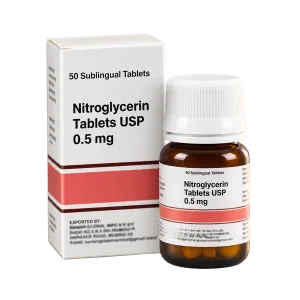
Nitroglycerin, also called glyceryl trinitrate or NTG, belongs to the organic nitrate class. The product is supplied as sublingual tablets containing nitroglycerin, intended to dissolve beneath the tongue for rapid absorption.
Therapeutic indications
The product is used for immediate relief of an established anginal attack. A prescribed dose may also be used shortly before predictable exertion when a clinician has established that approach for the individual patient. Nitroglycerin does not remove the underlying cause of coronary artery disease.
During angina, the clinical objective is to reduce myocardial oxygen demand quickly. Sublingual administration avoids much of the first-pass metabolism that limits the effect of swallowed nitrate tablets.
Nitroglycerin is included in standard cardiovascular treatment pathways for acute anginal symptoms. The American Heart Association and the American College of Cardiology describe sublingual nitroglycerin as an option for patients with ischemic chest discomfort when nitrate treatment is appropriate [1].
A practical distinction matters: relief of familiar angina does not prove that every episode of chest pain is harmless. New, severe, prolonged, or changing chest pain may represent acute coronary syndrome and requires emergency assessment.
How it affects the body
Nitroglycerin acts as a nitric oxide donor. After biotransformation in vascular tissues, it increases nitric oxide signalling and activates soluble guanylate cyclase inside vascular smooth muscle cells.
This raises cyclic guanosine monophosphate, or cGMP. The resulting intracellular changes reduce smooth muscle contraction and produce vasodilation. The response is strongest in large capacitance blood vessels, especially veins.
Venodilation reduces venous return to the heart, also called preload. A lower preload reduces ventricular filling pressure and wall tension. The heart then requires less oxygen to generate its next contraction.
Nitroglycerin can also dilate coronary arteries and improve blood flow in areas affected by coronary spasm. Its most consistent haemodynamic benefit in typical exertional angina comes from lowering cardiac workload rather than simply increasing oxygen delivery.
Vascular Smooth Muscle Relaxation Dynamics
Large capacitance veins can accommodate more blood when they relax. This pooling effect reduces the volume returning to the right side of the heart. The left ventricle subsequently pumps against lower filling pressure.
Resistance arterioles respond as well, especially at higher concentrations, but excessive arterial dilation may cause hypotension, dizziness, reflex tachycardia, or fainting. The balance between symptom relief and blood-pressure reduction explains why the prescribed dose is selected individually.
Nitroglycerin tolerance can develop with continuous nitrate exposure. For that reason, clinical regimens often include a daily nitrate-free interval when long-acting nitrate therapy is used. Intermittent sublingual treatment for attacks follows a different pattern, since each dose is used for a specific episode rather than maintaining constant blood levels. The EMA describes these pharmacological principles in its nitrate product information [2].
When not to use it
Nitroglycerin should not be used in the following circumstances unless a specialist has given a specific treatment plan:
- Current use of sildenafil, tadalafil, vardenafil, or another PDE5 inhibitor.
- Current use of riociguat.
- Severe hypotension, shock, or circulatory collapse.
- Severe anaemia or markedly reduced circulating blood volume.
- Raised intracranial pressure, including certain head injuries or brain haemorrhages.
- Known allergy to nitroglycerin or another organic nitrate.
- Suspected right-sided heart infarction, where venous filling may be essential to maintain cardiac output.
- Severe aortic or mitral valve obstruction, where the reduction in preload may be poorly tolerated.
The FDA prescribing information identifies nitrate-associated hypotension, PDE5 inhibitor interactions, and special cardiovascular precautions as central safety issues [3].
When this is not for you
Nitroglycerin is not suitable for everyone. Do not use it with sildenafil, tadalafil, vardenafil, or riociguat. Tell a clinician if you have very low blood pressure, severe anaemia, low blood volume, raised pressure inside the skull, an allergy to nitrates, certain heart attacks or valve problems. Alcohol and medicines for blood pressure can make the blood-pressure drop worse.
Possible side effects
Headache is the most characteristic adverse effect. It may be throbbing and can occur soon after the tablet dissolves. Dizziness, flushing, weakness, nausea, palpitations, and light-headedness may also occur because of vasodilation and blood-pressure changes.
More serious reactions include fainting, severe hypotension, marked tachycardia, worsening chest pain, and allergic swelling or breathing difficulty. A fainting episode after a dose requires urgent assessment, especially in someone with known heart disease.
Nitroglycerin can increase the frequency or severity of headache during the first period of use. Some people find that headaches lessen as the body adapts, while others cannot tolerate the medicine. Do not reduce or increase the dose independently.
One practical detail is easy to miss: alcohol can intensify dizziness and blood-pressure reduction. Combining alcohol with a nitrate is more concerning when the person has eaten little, is dehydrated, or takes other blood-pressure-lowering medicines.
Another detail concerns repeated exposure. Frequent nitrate use can indicate that the underlying angina is not adequately controlled. A growing need for rescue doses is a change in the pattern of disease, not merely a reason to carry more tablets.
Ingredients
The dose is selected individually, taking age, other medicines, and health conditions into account. The active ingredient is nitroglycerin.
Dosage and administration
Use the sublingual tablets exactly according to the individually selected regimen. Age, other medicines, blood pressure, kidney or liver conditions, and the pattern of angina all influence dose selection.
For the product described here:
- The active ingredient is nitroglycerin.
- The route is sublingual.
- Place one prescribed tablet beneath the tongue at the onset of familiar anginal pain.
- Do not chew or swallow the tablet as an ordinary oral dose.
- Remain seated, because dizziness or a sudden blood-pressure fall can occur.
- If pain continues after the first dose, emergency services should be contacted promptly rather than relying on repeated self-treatment.
- Chest pain that persists after the prescribed doses is an emergency.
A missed dose has a different meaning for an as-needed medicine. If no angina is present, do not take an extra tablet simply because a planned dose was missed. If a dose was intended before predictable exertion, use only the prescribed timing plan and do not double the amount.
Sublingual nitroglycerin does not need to be swallowed with food because it is absorbed through the tissues beneath the tongue. Food in the stomach does not provide the same interaction concern as it does for an ordinary swallowed tablet. The FDA's 2022 product information describes sublingual administration as the intended route for rapid relief.
Comparison
Nitroglycerin may be administered through sublingual tablets, sublingual sprays, topical preparations, or extended-release oral products. These forms are not interchangeable because their strengths, absorption patterns, and intended uses differ.
| Administration form | Practical feature | Clinical limitation |
|---|---|---|
| Sublingual tablet | Dissolves beneath the tongue for rapid mucosal absorption | Dissolution may be affected by dry mouth or incorrect placement |
| Sublingual spray | Delivers a measured spray to the oral mucosa | Requires correct spray technique and a compatible prescribed product |
| Swallowed extended-release tablet | Maintains nitrate exposure for prevention | Not intended to replace rapid treatment during an acute attack |
Sublingual tablets and sprays can both act quickly because they use the oral mucosa. A spray may provide more consistent delivery for some people, while a tablet is compact and does not require a pump mechanism. The available form should match the prescribed treatment plan.
Common mistakes
Several practical errors reduce the benefit of sublingual nitroglycerin:
- Swallowing the tablet instead of allowing it to dissolve under the tongue.
- Taking the dose while standing or walking.
- Repeating doses too quickly.
- Continuing to self-treat chest pain after the permitted maximum.
- Using nitroglycerin after taking sildenafil, tadalafil, vardenafil, or riociguat.
- Treating a new pattern of chest pain as ordinary angina.
- Doubling the dose after forgetting a planned preventive dose.
- Moving tablets into a humid container or leaving the bottle exposed to heat.
- Driving after a dose when dizziness or weakness is present.
- Assuming that the absence of headache means the medicine has not worked.
A patient should never use another person’s nitroglycerin. Similar symptoms can have different causes, and the medicines or dose strengths may not match.
What doctors say
In clinical practice, physicians focus first on whether the chest pain is stable and familiar. Nitroglycerin can relieve typical angina, yet it cannot safely classify every episode of chest discomfort.
Doctors also assess blood pressure, heart rate, the presence of heart failure, valve disease, recent infarction, anaemia, and concurrent medicines before selecting a nitrate regimen. The dose is decided individually, taking age, other medicines, and health conditions into account.
A clinician would usually want a clear record of how often rescue tablets are needed. Increasing frequency, pain at rest, reduced exercise tolerance, or symptoms that feel different from previous attacks can signal a change requiring urgent cardiac evaluation.
Nitrate response is not a diagnostic test. Pain that improves after nitroglycerin can still arise from more than one cause, including oesophageal spasm or other conditions that resemble angina.
Common questions
What should be done after a missed dose?
For as-needed angina treatment, there is no missed dose to replace when no symptoms are present. Do not take an extra tablet or double the next dose. The American Heart Association's 2021 patient guidance supports using sublingual nitroglycerin according to the established treatment plan and seeking emergency help when chest pain persists. A missed preventive dose should be handled according to the individual regimen rather than by taking two doses together.
Which habits can help or hinder the result?
Sitting down before administration, avoiding alcohol, and staying adequately hydrated can reduce dizziness and fainting risk. Heavy exertion during active chest pain can increase myocardial oxygen demand and delay recovery. The WHO's 2023 guidance describes tobacco exposure, physical inactivity, and uncontrolled cardiovascular risk factors as important contributors to ischemic heart disease [4]. Increasing reliance on rescue nitroglycerin is a reason to reassess the angina pattern rather than simply changing the dose independently.
Can nitroglycerin be taken with food?
Sublingual nitroglycerin does not need to be swallowed with food because it is absorbed through the tissues beneath the tongue. Food in the stomach does not provide the same interaction concern as it does for an ordinary swallowed tablet. The FDA's 2022 product information describes sublingual administration as the intended route for rapid relief. Alcohol is different: it can intensify vasodilation, dizziness, and low blood pressure.
Can nitroglycerin affect driving, concentration, or machinery work?
Nitroglycerin can cause dizziness, blurred vision, weakness, headache, or fainting, especially after the first doses or when blood pressure falls. Do not drive, climb, or operate machinery if any of these effects occur. The EMA's 2018 product information identifies hypotension and neurological symptoms such as dizziness as clinically relevant nitrate reactions. Emergency chest pain itself also makes driving unsafe, even if the medicine reduces the discomfort.
How quickly should sublingual nitroglycerin begin to help?
Sublingual nitroglycerin is intended to act rapidly because it dissolves in the oral mucosa rather than passing first through the digestive tract. Relief should not be judged by taking repeated tablets close together. If symptoms continue after the first dose or meet the emergency thresholds described in the treatment plan, emergency services should be contacted. The WHO's 2023 cardiovascular guidance supports urgent assessment for persistent or severe chest pain.
Do you offer anonymous delivery?
Your order will be securely packed and shipped within 24 hours. This is exactly what your package will look like (images of an actual item sent). It has the size and look of a regular private letter (24x11x0.7 cm) and its contents cannot be seen.
Comparison
Storage
Nitroglycerin products also differ in storage sensitivity. Heat, moisture, and repeated exposure to air can affect nitrate tablets. Keep the medicine in the storage conditions specified for the product and avoid transferring tablets into an unlabelled pill organiser, since this can expose them to unsuitable humidity.
How Buyers Rate Nitroglycerin
-
Waleed, 32 Dibba Al-Fujairah 15 Nov 2026Rating: 5 out of 5I used the 0.5 mg tablet during the familiar chest tightness my cardiologist had discussed with me. I stayed seated, let it dissolve under my tongue, and felt the pressure ease within a few minutes. Carrying the small bottle made the treatment easier to keep available.
-
Meera, 54 Al Reem Island 22 Nov 2026Rating: 2.5 out of 5The tablet did not help the episode I had, and the headache and dizziness were unpleasant. I stopped taking further doses and contacted my doctor because the pain felt different from my usual symptoms. The main lesson for me was not to assume every chest pain episode is ordinary angina.
-
Fatima, 27 Al Majaz 18 Nov 2026Rating: 5 out of 5The tablets gave me noticeable relief during the episodes that followed exertion. I placed one under my tongue while sitting down, and the pressure settled faster than when I tried to continue walking. The administration method was simple once I understood that it should not be swallowed.
-
Divya, 63 Umm Al Quwain 25 Oct 2026Rating: 4.5 out of 5I found the medicine helpful for the predictable symptoms my cardiologist had already identified as angina. The effect came quickly when I used the tablet correctly, and keeping the bottle in its proper storage place helped me remember where it was.
Sources
- American Heart Association and American College of Cardiology (2021). 2021 AHA/ACC Guideline for the Evaluation and Diagnosis of Chest Pain
- European Medicines Agency (2023). Summary of Product Characteristics (SmPC) — glyceryl trinitrate
- U.S. Food and Drug Administration (2022). Nitroglycerin Sublingual Tablets — FDA prescribing information
- World Health Organization (2023). Cardiovascular diseases — WHO fact sheet
