
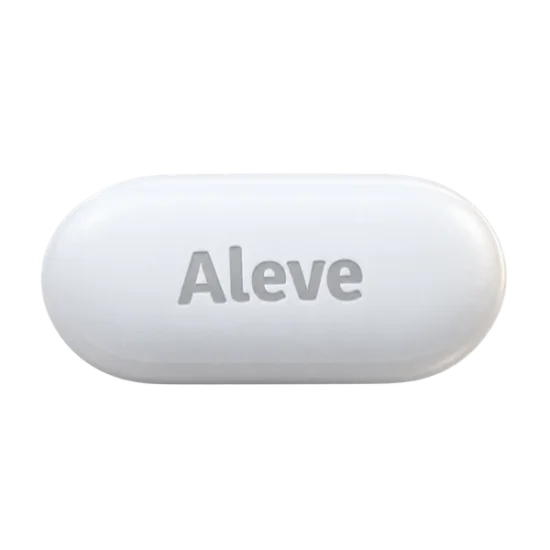
- Only original products
- Worldwide Delivery
- 24/7 Support
Aleve tablets are taken by mouth for temporary pain and fever relief. The medicine reduces prostaglandin production, helping ease pain, inflammation, and raised temperature.
Product information
Aleve tablets are taken by mouth for temporary pain and fever relief. They contain naproxen sodium, an NSAID used by adults for headaches, toothache, backache, menstrual pain, muscle pain, and arthritis symptoms.
Therapeutic indications
Aleve is used for short-term relief of several common painful conditions. The response depends on the cause, severity, duration, and individual health factors.
- Headache: Naproxen can reduce pain associated with tension-type headaches and some migraine attacks.
- Toothache: Its anti-inflammatory action may reduce dental pain while definitive dental treatment is arranged.
- Backache: It can help with inflammatory or musculoskeletal back pain.
- Muscle pain: Strains, overuse, and minor soft-tissue inflammation may respond to an NSAID.
- Menstrual pain: Prostaglandins contribute to uterine cramping, so naproxen may reduce menstrual pain and associated lower-back discomfort.
- Arthritis: Naproxen can relieve pain, stiffness, and swelling linked with osteoarthritis or rheumatoid arthritis.
- Fever: Its antipyretic effect can lower an elevated temperature when fever is associated with an appropriate short-term illness.
Pain from a fracture, serious injury, infection, or worsening abdominal condition requires assessment of the cause rather than repeated self-treatment. Aleve can reduce symptoms without correcting the underlying problem.
| Condition | Main symptom target | Typical response pattern |
|---|---|---|
| Headache or toothache | Pain and inflammation | Relief may begin after absorption, with duration lasting several hours |
| Muscle pain or backache | Musculoskeletal pain and stiffness | Improvement may occur during the first treatment day |
| Menstrual pain or arthritis | Cramping, joint pain, and inflammation | Repeated dosing may be needed within the prescribed schedule |
How it affects the body
Naproxen inhibits cyclo-oxygenase enzymes, commonly called COX-1 and COX-2. These enzymes help produce prostaglandins from arachidonic acid. Lower prostaglandin levels reduce the sensitivity of pain receptors and help lower the inflammatory response.
That mechanism explains both the benefits and the main risks of NSAID treatment. Reduced prostaglandins can ease joint pain and fever, while reduced protective prostaglandins in the stomach and kidneys can increase the risk of gastrointestinal irritation, bleeding, fluid retention, or impaired kidney function.
When not to use it
Aleve is not for you if you have had an allergic reaction, asthma attack, facial swelling, or severe skin reaction after naproxen, aspirin, or another NSAID. It is also unsuitable for people with active stomach or intestinal ulceration, current gastrointestinal bleeding, or severe kidney, liver, or heart failure unless a specialist has given specific instructions.
Avoid self-treatment with Aleve in the following situations:
- Recent or planned coronary artery bypass surgery.
- Previous NSAID-related gastrointestinal bleeding.
- Uncontrolled high blood pressure or significant cardiovascular disease.
- Severe dehydration.
- Known kidney disease.
- Active inflammatory bowel disease with gastrointestinal bleeding.
- Pregnancy during the third trimester.
Naproxen may interact with warfarin and other anticoagulants, aspirin, clopidogrel, corticosteroids, SSRIs, lithium, methotrexate, ciclosporin, tacrolimus, diuretics, ACE inhibitors, and angiotensin-receptor blockers. These combinations can increase bleeding, kidney, blood-pressure, or toxicity risks. [3]
When this is not for you
Aleve may not be suitable if you have had serious reactions to painkillers in the NSAID family, a stomach ulcer or bleeding, or severe problems affecting the kidneys, liver, or heart. Extra caution is needed if you are dehydrated, have high blood pressure or cardiovascular disease, are pregnant late in pregnancy, or take medicines that raise bleeding or kidney risks.
Tell a clinician about all medicines you use before taking Aleve, especially blood thinners, aspirin, steroids, antidepressants, lithium, methotrexate, water tablets, or blood-pressure medicines. Pregnancy and breastfeeding should be discussed individually rather than managed through self-treatment.
Possible side effects
Common reactions include indigestion, stomach discomfort, nausea, heartburn, dizziness, headache, and constipation. These effects are related to NSAID activity or to individual sensitivity. Taking the tablet with food may reduce stomach upset, but it does not remove the possibility of ulceration or bleeding. [2]
Stop using Aleve and seek urgent medical attention for:
- Vomiting blood or material resembling coffee grounds.
- Black, tarry stools or blood in the stool.
- Severe or persistent stomach pain.
- Facial swelling, wheezing, breathing difficulty, or widespread blistering rash.
- Sudden chest pain, weakness on one side, slurred speech, or severe shortness of breath.
- Markedly reduced urination or sudden swelling of the legs.
NSAIDs can cause gastrointestinal bleeding without early warning symptoms. Risk rises with older age, previous ulcer disease, higher exposure, prolonged use, alcohol excess, corticosteroids, anticoagulants, antiplatelet medicines, and selective serotonin reuptake inhibitors.
Naproxen can also cause fluid retention and increased blood pressure. People with heart or kidney conditions may be more vulnerable, especially during dehydration, vomiting, diarrhoea, or hot weather. Blood-pressure changes may occur without obvious symptoms. Kidney function can worsen during severe fluid loss. People at higher risk may need clinical monitoring before repeated use.
A mild headache or nausea may settle, but a new rash, facial swelling, breathing problem, or sudden change in urine output needs prompt attention.
Ingredients
Aleve contains naproxen sodium, a nonsteroidal anti-inflammatory drug (NSAID). NSAIDs reduce the production of prostaglandins, chemical messengers involved in pain, swelling, and fever. Naproxen sodium is absorbed after oral administration and converted to naproxen, the active form responsible for its pharmacological effects. [1]
The product is supplied as tablets. It is intended for systemic action, which means the active ingredient enters the bloodstream and can affect pain and inflammation throughout the body rather than only at the point of application.
Dosage and administration
The amount taken at each intake is selected individually. Use the lowest amount that provides relief for the shortest suitable period, following the dosing schedule appropriate for the product and your medical circumstances.
- Take the tablets by mouth with water.
- Swallow the tablet rather than crushing or chewing it.
- Do not take more than the selected amount because pain has not settled immediately.
- Do not combine Aleve with another naproxen product or other NSAIDs.
- If treatment is needed repeatedly, reassess the cause of the pain rather than extending self-treatment indefinitely.
For a missed dose, take it when remembered if the next scheduled intake is not close. If the next intake is near, skip the missed dose and return to the planned schedule. Never double the next intake to compensate.
Aleve is intended for temporary relief of pain and fever. Persistent pain, recurrent fever, black stools, vomiting blood, or new weakness requires medical assessment.
Aleve can be taken with water, with or after food. Food may reduce stomach discomfort but does not completely protect against ulcers or bleeding. People with a history of stomach ulcers or bleeding need an individual treatment plan.
Comparison
Aleve belongs to the NSAID group. Other pain-relief approaches act differently and may suit people with different risks.
| Approach | Main action | Main limitation |
|---|---|---|
| Naproxen sodium | Reduces prostaglandin production and inflammation | Can irritate the stomach and affect kidneys, blood pressure, or fluid balance |
| Paracetamol | Reduces pain and fever through central mechanisms | Provides little peripheral anti-inflammatory action and can harm the liver in excessive amounts |
| Topical anti-inflammatory treatment | Delivers an NSAID through the skin near a painful area | Less suitable for widespread pain, deep joint symptoms, or conditions outside the application area |
Naproxen may be preferred when inflammation contributes to the pain. Paracetamol may be considered when an NSAID is unsuitable, though it has its own liver-related risks. A topical option may limit whole-body exposure for local muscle or joint pain.
Aleve should not be selected solely because it lasts longer. A history of stomach ulcer, kidney disease, heart failure, uncontrolled hypertension, or cardiovascular disease can change the balance of benefit and risk.
Common mistakes
Several practical errors reduce benefit or increase risk:
- Taking Aleve together with ibuprofen because the products have different brand names.
- Repeating a dose too soon when relief has not yet reached its full effect.
- Using it for several days without reassessing persistent pain.
- Taking it while dehydrated after vomiting, diarrhoea, or heavy exercise.
- Continuing treatment despite black stools, facial swelling, or reduced urination.
- Assuming that food removes the risk of ulceration.
- Forgetting to mention naproxen when a clinician prescribes an anticoagulant, lithium, methotrexate, or blood-pressure medicine.
- Using Aleve to treat a fever that is persistent, severe, or accompanied by confusion, neck stiffness, breathing difficulty, or a spreading rash.
What doctors say
In clinical practice, doctors often choose naproxen when inflammation is a clear part of the pain pattern, such as joint stiffness, menstrual cramps, or musculoskeletal injury. They also review gastrointestinal, kidney, blood-pressure, cardiovascular, pregnancy, and interaction risks before recommending repeated use.
A useful prescribing principle is simple: control the condition with the smallest suitable exposure. Longer treatment does not automatically produce better recovery. An NSAID can reduce pain enough to improve movement, but continuing to overload an injured joint or muscle may prolong the original problem.
The European Medicines Agency recognises NSAID-related gastrointestinal and cardiovascular risks as class considerations, with risk influenced by dose and treatment duration. [4] The World Health Organization also places medication safety within the wider assessment of the person, the indication, and other medicines being used. NICE guidance, Cochrane reviews, and MHRA safety communications provide additional perspectives on NSAID prescribing and risk assessment.
Doctors may choose stomach protection for people at increased ulcer risk, but that decision depends on personal risk factors and the other medicines involved. A stomach-protective medicine does not prevent every NSAID complication.
Common questions
How long does one Aleve dose keep working?
One dose commonly provides pain relief for about 8 to 12 hours, although individual response varies. Naproxen sodium has a longer clinical duration than some shorter-acting analgesics because naproxen remains in the body for an extended period. The FDA describes naproxen products as providing temporary relief of minor aches, pains, and fever when used according to their directions, based on its 2022 naproxen sodium labeling. [5] Longer action does not justify taking doses closer together.
What should I do after missing an Aleve dose?
Take the missed dose when remembered if the next scheduled intake is not near. Skip it when the next intake is close, then continue with the planned schedule. Do not double the next amount, because taking extra naproxen increases gastrointestinal, kidney, and cardiovascular exposure. FDA naproxen labeling published in 2022 supports avoiding compensatory double dosing with medicines that can cause dose-related harm.
What happens when Aleve is stopped, and does it need tapering?
Aleve does not usually require tapering when used for short-term pain relief. Its analgesic and anti-inflammatory effects gradually wear off as naproxen leaves the body. Pain or fever may return if the original condition remains active, but that is a return of symptoms rather than a withdrawal syndrome. European Medicines Agency safety information from 2012 supports limiting NSAID treatment to the period needed for symptom control.
Can Aleve be used during pregnancy or breastfeeding?
Aleve should be avoided during the third trimester of pregnancy because NSAIDs can affect fetal circulation and labour. Earlier pregnancy and breastfeeding require an individual assessment of the indication, treatment duration, and available alternatives. European Medicines Agency safety information from 2012 supports caution with NSAID use throughout pregnancy, with stronger restrictions later in gestation. Naproxen passes into breast milk in small amounts, so infant age and treatment length matter.
Can Aleve cause stomach bleeding?
Yes. Aleve can cause indigestion, ulceration, or gastrointestinal bleeding, sometimes without early warning symptoms. The risk is higher with previous ulcers, anticoagulants, corticosteroids, SSRIs, alcohol excess, older age, or prolonged NSAID use. The World Health Organization’s 2017 Medication Without Harm framework supports urgent attention to serious suspected adverse reactions, including gastrointestinal bleeding.
How soon does Aleve start to relieve pain?
Some people notice improvement within the first hour after oral administration, while others need longer or obtain only partial relief. The onset depends on the condition, whether the tablet was taken with food, and individual absorption. Naproxen sodium is absorbed relatively promptly, according to FDA naproxen labeling from 2022. Severe pain that does not respond should not lead to extra dosing outside the planned schedule.
Can Aleve be taken with food or on an empty stomach?
Aleve can be taken with water, with or after food. Food may reduce stomach discomfort but can delay absorption slightly, so it does not provide complete protection against ulcers or bleeding. FDA naproxen labeling from 2022 advises attention to stomach symptoms and avoidance of combining naproxen with other NSAIDs. People with previous ulcer disease or bleeding risk need a specific treatment plan rather than relying only on food.
Do you offer anonymous delivery?
Your order will be securely packed and shipped within 24 hours. This is exactly what your package will look like (images of an actual item sent). It has the size and look of a regular private letter (24x11x0.7 cm) and its contents cannot be seen.
Comparison

How Buyers Rate Aleve
-
Mark C., 48 Jebel Ali · Several days 25 Oct 2026Rating: 2.5 out of 5I took Aleve as directed for several days for lower-back pain after several days of stiffness. It did not make enough difference for me, and the pain continued, so I stopped relying on it.
-
Daniel, 39 Jumeirah · One day 31 Oct 2026Rating: 5 out of 5I took Aleve as directed for one day for a painful headache and felt a clear improvement later that day. The relief lasted through the evening, which was useful because shorter-acting tablets had worn off sooner.
-
Majid G., 32 Ras Al Khaimah · One day 6 Nov 2026Rating: 5 out of 5I took Aleve as directed for one day, and it helped with muscle soreness after a demanding week. I could move more comfortably the next morning, and the tablets were easy to take with breakfast.
-
Ramon, 50 Umm Al Quwain · Several days 12 Nov 2026Rating: 3.5 out of 5I took Aleve as directed for several days. It reduced my knee pain, although the improvement was slower than I expected. I also noticed mild heartburn, so I stopped using it regularly and discussed other options with my doctor.
-
Mohammed, 43 Dubai Marina · One night 20 Nov 2026Rating: 4.5 out of 5I took Aleve as directed for one night for dental pain before my appointment. It took the edge off and made the night easier, although I still needed the dental treatment for the underlying problem.
Sources
- U.S. Food and Drug Administration (2022). Drug Facts Label — naproxen sodium tablets.
- U.S. Food and Drug Administration (2022). Prescribing information and labeling for naproxen-containing products.
- World Health Organization (2017). Medication Without Harm: Global Patient Safety Challenge.
- European Medicines Agency (2012). Safety information for non-steroidal anti-inflammatory drugs (NSAIDs).
- U.S. Food and Drug Administration (2022). Drug Facts Label — over-the-counter naproxen sodium.
