
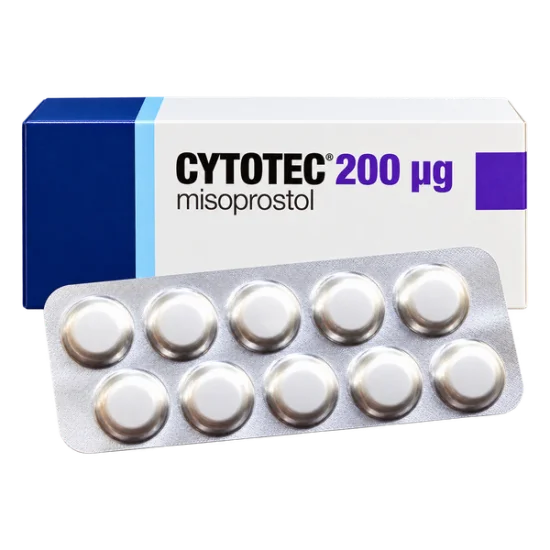
Cytotec
Active ingredient: Misoprostol
Delivery: from 4 days
- Only original products
- Worldwide Delivery
- 24/7 Support
Cytotec is used in clinical care for gastric-ulcer prevention in selected patients and in medication-abortion protocols under an appropriate medical regimen.[1] Misoprostol changes prostaglandin activity at local tissue receptors.
Product information
Adults prescribed Cytotec receive tablets containing misoprostol, a synthetic prostaglandin E1 analogue. The product is supplied as 200 microgram tablets and acts on smooth muscle in the uterus and gastrointestinal tract.
Therapeutic indications
Cytotec is used in clinical care for gastric-ulcer prevention in selected patients and in medication-abortion protocols under an appropriate medical regimen.[1]
Medication abortion uses medicines to end an intrauterine pregnancy and support expulsion of the pregnancy tissue. A commonly used combination contains mifepristone followed by misoprostol. Mifepristone blocks progesterone activity, while Cytotec supplies misoprostol, which causes cervical softening and uterine contractions.[2]
The appropriate schedule changes according to whether the indication is ulcer prevention, medication abortion, miscarriage management, cervical preparation, or another clinical use.
How it affects the body
Misoprostol changes prostaglandin activity at local tissue receptors. In the stomach, it reduces acid secretion and supports protective mucus and bicarbonate production. In the uterus, it softens the cervix and stimulates uterine contractions. The same pharmacology explains both its therapeutic uses and its characteristic cramping, bleeding, diarrhoea, nausea, and chills.
When not to use it
Cytotec is not suitable for everyone. It is not appropriate for a person who:
- Has a known allergy to misoprostol or another prostaglandin analogue.
- May have an ectopic pregnancy or has symptoms suggesting one.
- Is using misoprostol for ulcer prevention while pregnant.
- Has a medical condition in which uterine contractions or heavy bleeding create serious danger.
- Cannot access urgent medical care when the prescribed regimen requires monitoring or follow-up.
- Has been told to avoid the planned pain-relief medicines because of kidney, stomach, bleeding, or allergic risks.
A person with a caesarean-scarred uterus, bleeding disorder, severe anaemia, chronic adrenal disease, or anticoagulant treatment may need a modified clinical plan. These factors do not produce one universal answer; they change the assessment before starting.
Ibuprofen may be unsuitable with active peptic ulcer disease, significant kidney impairment, certain anticoagulants, or previous NSAID-triggered asthma. Aspirin can increase bleeding tendency. Methotrexate, anticoagulants, corticosteroids, and medicines affecting immune function may require specific review according to the clinical situation.
When this is not for you
Cytotec is NOT for you if you may have an ectopic pregnancy, have a relevant allergy, or cannot access urgent medical care when the regimen requires monitoring.
Pregnancy status and pregnancy location are central to safe use. Breastfeeding also requires an indication-specific discussion. Misoprostol passes into breast milk in very small amounts, while the reason for treatment, the co-administered medicine, and the infant’s health may affect the advice.
Possible side effects
Uterine cramping and vaginal bleeding are expected pharmacological responses when misoprostol is used in a medication-abortion protocol. Cramping can be mild, moderate, or intense. Bleeding may be heavier than a usual menstrual period and can include clots. These effects vary with gestational age, route, individual sensitivity, and whether mifepristone was used first.
| Response | Clinical meaning | Action |
|---|---|---|
| Cramping and pelvic pressure | Uterine contraction | Use the agreed pain-relief plan and monitor severity |
| Vaginal bleeding and clots | Uterine emptying may be occurring | Monitor the pattern and seek urgent care for excessive bleeding |
| Nausea, diarrhoea, chills, or feverish feelings | Prostaglandin-related effects | Hydrate and obtain advice if symptoms are severe or persistent |
Misoprostol can also cause headache, dizziness, vomiting, constipation, skin rash, and transient fever. Chills often settle as the prostaglandin effect declines. A fever that persists, returns later, or occurs with worsening abdominal pain can indicate infection and needs prompt assessment.
Bleeding that becomes progressively heavier, causes weakness, or is accompanied by fainting is not suitable for home observation.
Ingredients
Adults prescribed Cytotec receive tablets containing misoprostol, a synthetic prostaglandin E1 analogue. The product is supplied as 200 microgram tablets.
Dosage and administration
The regimen for Cytotec must be confirmed with a healthcare professional before starting. The appropriate schedule changes according to whether the indication is ulcer prevention, medication abortion, miscarriage management, cervical preparation, or another clinical use.
- Take or use Cytotec only by the route and schedule prescribed for the specific indication.
- Do not substitute the tablet strength for a different regimen.
- Do not take extra tablets because bleeding has not started quickly.
- Do not repeat a dose without the agreed clinical plan.
- If a dose is missed or vomited, obtain instructions before taking more.
- Record the time of use, onset of cramping, bleeding pattern, temperature, and any unusual symptoms.
Cytotec tablets can cause uterine contractions even when the pregnancy outcome is uncertain. People who may be pregnant should not take misoprostol for gastric-ulcer prevention because it can cause miscarriage, premature labour, or birth defects. Medication-abortion use is a separate clinical indication with its own assessment and follow-up pathway.
Do not share Cytotec with another person. A regimen suitable for one indication may be unsuitable for another, and symptoms can overlap between expected effects and complications.
Comparison
Medication abortion and surgical abortion are established clinical approaches with different practical features. The choice depends on gestational age, medical history, examination findings, patient preference, local clinical pathways, and the availability of urgent care.
| Medication abortion | Surgical abortion |
|---|---|
| Uses mifepristone, misoprostol, or misoprostol alone in a defined regimen | Uses an aspiration procedure to remove pregnancy tissue |
| Cramping and bleeding occur during the process, often outside a procedure room | The procedure occurs in a clinical setting with trained staff |
| The process may take longer and requires attention to symptoms and follow-up | Treatment is usually completed during a clinical visit, with recovery afterward |
Medication abortion can offer privacy and avoids an intrauterine procedure, although pain, bleeding, uncertainty about completion, and the possibility of additional treatment can be difficult for some patients. Surgical abortion can provide a more predictable procedural endpoint, though it involves instrumentation, clinical attendance, and procedure-related risks.
Common mistakes
The most frequent errors involve timing, duplicate dosing, and confusing expected effects with complications.
- Using a gastric-ulcer regimen for medication abortion, or the reverse.
- Taking extra tablets because bleeding has not begun within the expected time.
- Assuming that bleeding confirms completion without follow-up.
- Taking aspirin for cramping despite a bleeding concern.
- Starting antibiotics without an assessment for infection.
- Ignoring one-sided pain, fainting, or shoulder-tip pain.
- Forgetting to mention anticoagulants, anaemia, a bleeding disorder, or a previous caesarean birth.
- Stopping follow-up once bleeding becomes lighter.
- Taking Cytotec during a possible pregnancy for an unrelated stomach indication.
What doctors say
In clinical practice, doctors focus first on the indication, pregnancy location when relevant, gestational age, bleeding risk, and access to emergency assessment. The tablet itself does not provide a complete treatment plan. The regimen must match the reason Cytotec is being prescribed.
A physician will usually explain which symptoms are expected, which symptoms are dangerous, and how completion will be assessed. Clear instructions reduce two common problems: taking additional tablets too soon and waiting too long with warning signs.
The World Health Organization describes medication abortion as a clinical process requiring suitable information, medicines, pain management, and follow-up access rather than a single tablet taken without context. A doctor will also consider whether surgical management would be more suitable if there is heavy bleeding, suspected ectopic pregnancy, failed treatment, or a medical contraindication.
One small detail often overlooked is the value of planning transport before treatment. Severe cramping can make driving difficult, and dizziness can appear after pain, bleeding, vomiting, or inadequate fluid intake.
Common questions
Can Cytotec be used during pregnancy or breastfeeding?
Misoprostol can cause uterine contractions, miscarriage, premature labour, and fetal harm, so it is not used for gastric-ulcer prevention during pregnancy. In medication-abortion care, it is used for a different clinical purpose under a defined regimen and assessment. The World Health Organization’s 2022 guidance recognises misoprostol as part of medication-abortion care while stressing appropriate clinical information and follow-up. Breastfeeding advice depends on the indication, any accompanying medicine, and the infant’s health, so the treating clinician should provide the plan before starting.
How long does one dose of Cytotec keep working?
The uterine effects of misoprostol begin and decline over a variable period, influenced by the route, dose, pregnancy duration, and whether mifepristone was used. Cramping and bleeding may start within hours, while lighter bleeding or spotting can continue afterward. A person should not take another dose simply because the first dose has not produced immediate bleeding. WHO clinical guidance published in 2022 treats repeat dosing as part of a defined regimen, not as an unsupervised response to anxiety or delay.
Which symptoms mean that Cytotec should be stopped and urgent care sought?
Seek urgent care for collapse, fainting, severe weakness, breathing difficulty, severe or persistent abdominal pain, or rapidly heavy bleeding. One-sided pain, shoulder-tip pain, or severe pain with little bleeding requires urgent assessment because misoprostol does not treat ectopic pregnancy. Persistent fever, foul-smelling discharge, worsening pelvic tenderness, or a deteriorating general condition can indicate infection. The American College of Obstetricians and Gynecologists (2020) identifies heavy bleeding, severe pain, and ongoing pregnancy symptoms as reasons for clinical assessment in medication-abortion care.
What happens after stopping Cytotec, and is tapering required?
Misoprostol is generally used as a defined short regimen rather than a medicine that requires gradual tapering. After the planned course ends, prostaglandin-related cramping, nausea, chills, and diarrhoea usually settle as the drug effect declines. Bleeding may continue or become lighter, and completion still needs the follow-up method specified in the clinical plan. The FDA prescribing information from 2002 for Cytotec describes indication-specific dosing rather than a tapering schedule.
Do you offer anonymous delivery?
Your order will be securely packed and shipped within 24 hours. This is exactly what your package will look like (images of an actual item sent). It has the size and look of a regular private letter (24x11x0.7 cm) and its contents cannot be seen.
How Buyers Rate Cytotec
-
Ali, 61 Madinat Zayed · Over the following days 25 Oct 2026Rating: 4 out of 5I used the 200 microgram tablet as part of the plan given to me and noticed the expected stomach benefit over the following days. The instructions were straightforward, and I was satisfied with the result.
-
Hina, 30 Al Qusais · One day 4 Nov 2026Rating: 4.5 out of 5My prescribed Cytotec schedule was completed over one day. The cramping was manageable with the pain relief I had been told to use, and the follow-up confirmed that the treatment had worked.
-
Mariam, 44 Liwa · Later that day 10 Nov 2026Rating: 5 out of 5I used Cytotec with the accompanying medicine in the clinical plan. Bleeding started later that day, and the process was finished without needing an additional procedure. I felt satisfied because I knew what symptoms to expect.
-
Hamza D., 33 Ras Al Khaimah · The first few hours 16 Nov 2026Rating: 3 out of 5The treatment produced the expected cramping and bleeding, but the first few hours were more uncomfortable than I had anticipated. The process worked, although I needed the agreed pain relief and preferred having someone nearby.
-
Grace, 68 Fujairah · The short trial 22 Nov 2026Rating: 2 out of 5Cytotec did not provide the stomach relief I had hoped for during the short trial. Nausea and abdominal discomfort made me stop, and I arranged a medical review rather than taking more tablets.
Sources
- U.S. Food and Drug Administration (2002). Cytotec (misoprostol) Tablets Prescribing Information
- World Health Organization (2022). Abortion Care Guideline
