
- Only original products
- Worldwide Delivery
- 24/7 Support
Women in the postmenopausal range with vaginal dryness, irritation, or discomfort during sex may use local Estriol cream for genitourinary symptoms. Estriol is a short-acting oestrogen that supports vaginal tissue, moisture, elasticity, and a healthier local pH.
Product information
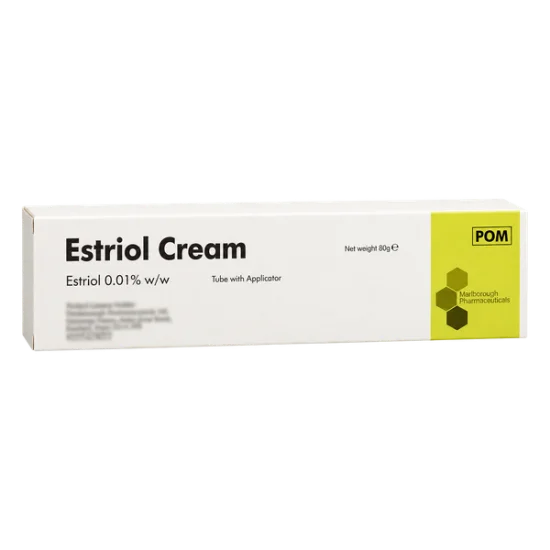
Estriol cream contains estriol 0.01% w/w in a tube with an applicator. It is intended for vaginal use, where the active ingredient acts on oestrogen receptors in the vaginal and lower urinary tissues. Local oestrogen treatment is used for genitourinary syndrome of menopause, a group of symptoms caused by reduced oestrogen after menopause.
Estriol has shorter receptor activity than estradiol. Its activity promotes maturation of the vaginal epithelium, improves blood supply, and supports the return of moisture and elasticity.
The degree of absorption can be greater when vaginal tissue is severely atrophic at the start of treatment [1].
Therapeutic indications
Vaginal Estriol is used for local symptoms linked to oestrogen deficiency. These symptoms can affect daily comfort, sexual activity, sleep, exercise, and urinary health.
Common treatment goals include:
- Reducing vaginal dryness and irritation.
- Improving vaginal moisture and tissue thickness.
- Easing burning or soreness.
- Reducing pain during sex caused by tissue fragility.
- Supporting a more acidic vaginal pH.
- Improving urinary discomfort associated with genitourinary syndrome of menopause.
- Lowering the frequency of recurrent urinary tract infections in some postmenopausal women.
Potential drawbacks include gradual onset, local irritation, and the need to assess unexpected bleeding.
| Target symptom | Tissue response |
|---|---|
| Dryness and burning | Greater moisture and epithelial maturation |
| Pain during sex | Improved elasticity and reduced tissue fragility |
| Recurrent urinary symptoms | Better local oestrogen activity around vaginal and urethral tissues |
Local oestrogen does not work as a general painkiller. Relief comes from gradual tissue repair, improved lubrication, and restoration of the vaginal environment. Some people notice less irritation first, while pain during sex can require a longer period of tissue recovery.
Clinical guidance from NICE supports vaginal oestrogen for genitourinary symptoms of menopause, including dryness and discomfort during sex. Local treatment can be continued for as long as symptoms remain troublesome, with periodic review of benefit and tolerability [2].
How it affects the body
Estriol binds to oestrogen receptors in vaginal tissue and stimulates cellular maturation. Its activity promotes maturation of the vaginal epithelium, improves blood supply, and supports the return of moisture and elasticity.
After menopause, lower oestrogen activity can make vaginal tissue thinner, less elastic, and more fragile. The vaginal pH may rise, and the protective lactobacillus-dominant environment can change.
When not to use it
Estriol is not suitable for everyone. It is not for you if you have a known or suspected oestrogen-dependent cancer, unexplained vaginal bleeding, active or previous venous thromboembolism linked to oestrogen treatment, or a serious liver disorder that affects oestrogen metabolism.
Additional caution is needed with:
- Previous breast cancer or endometrial cancer.
- A history of blood clots, stroke, or heart attack.
- Severe migraine with neurological symptoms.
- Active liver disease.
- Gallbladder disease worsened by oestrogen.
- Endometriosis or uterine fibroids.
- Pregnancy or possible pregnancy.
- Breastfeeding.
- Allergy to estriol or an excipient in the cream.
Some medicines that induce liver enzymes may reduce oestrogen exposure. Examples include certain anticonvulsants, rifampicin-type antibiotics, and St John’s wort. Corticosteroids and medicines affected by oestrogen can also require review.
The EMA describes local vaginal oestrogen as a treatment requiring attention to dose, duration, systemic exposure, and endometrial symptoms, especially with prolonged use [4].
When this is not for you
Do not use Estriol without medical advice if you have had breast or endometrial cancer, unexplained bleeding after menopause, blood clots, stroke, heart attack, serious liver disease, or severe migraine with neurological symptoms. Tell the prescriber if you are pregnant, breastfeeding, have endometriosis or fibroids, or are allergic to estriol. Medicines for epilepsy, infections, anticoagulation, cancer, and herbal products such as St John’s wort may also need review before treatment.
Possible side effects
Common local reactions include temporary burning, itching, irritation, discharge, or breast tenderness. Headache, nausea, fluid retention, or mood changes are less common but can occur with oestrogen exposure. New or persistent symptoms require clinical assessment rather than repeated self-adjustment of the cream.
Low-dose vaginal Estriol is designed for local treatment, and systemic exposure is generally lower than with an oestrogen tablet, patch, or gel used for whole-body hormone replacement. Absorption can still occur, especially during the first weeks when the vaginal lining is thin.
A small amount of spotting can occur when fragile tissue begins to recover, but bleeding after menopause should not be assumed to be harmless. Report it promptly so the cause can be assessed.
A clinical review of low-dose vaginal oestrogen studies found that systemic estradiol concentrations generally remain within or close to postmenopausal ranges, with variation between products and treatment stages [3].
Ingredients
Estriol cream contains estriol 0.01% w/w as the active ingredient. It is supplied in an 80 g tube with an applicator for vaginal use.
Dosage and administration
The dose of Estriol is decided individually, taking age, other medicines, and health conditions into account. A clinician may use a short initial phase followed by a maintenance schedule, depending on symptom severity and the product’s prescribing instructions.
A commonly used clinical pattern for low-dose vaginal oestrogen is:
- An initial daily application for about two weeks.
- A maintenance application twice weekly after the initial phase.
- Adjustment according to symptom control, tolerability, and clinical review.
This schedule is a general clinical pattern, not a substitute for the regimen selected for an individual patient. The amount applied with the tube applicator should match the prescribed instruction.
Symptoms may begin to improve within two to four weeks. Dryness and burning can settle before deeper tissue changes are complete. Full tissue benefit may take several months, and symptoms can return when treatment is stopped.
A missed application should generally be used when remembered if it is not close to the next scheduled application. If the next application is due soon, skip the missed one and return to the usual schedule. Doubling the amount is not a useful way to compensate.
Treatment may need to continue because genitourinary symptoms often return when local oestrogen is withdrawn. This differs from a short course intended to eradicate an infection.
The applicator helps place the cream inside the vagina rather than only around the outer vulval skin. External symptoms may still require a clinician-directed adjustment in application technique. Cream should not be used in the eyes, mouth, or on unrelated areas of skin.
Comparison
Estriol and estradiol are both oestrogens, but they differ in receptor potency, duration of action, and the formulations used in clinical practice.
| Feature | Estriol | Estradiol |
|---|---|---|
| Receptor activity | Shorter-acting and generally less potent | Stronger, longer-lasting oestrogen activity |
| Local forms | Vaginal cream and pessary | Vaginal tablet, ring, cream, and other local forms |
| Main treatment focus | Local vaginal and urinary symptoms | Local symptoms or systemic menopausal symptoms, depending on form |
Estradiol is used in a vaginal tablet and in other local preparations. It can provide strong local receptor stimulation, while transdermal or oral forms produce wider systemic effects. Estriol cream is often selected when the clinical objective is local tissue support with a short-acting oestrogen.
Potency does not determine which option is best by itself. Tissue severity, bleeding history, cancer history, urinary symptoms, previous treatment response, and tolerance all influence selection.
Vaginal moisturisers can support ongoing hydration and may be used regularly between sexual activity or treatment applications. Lubricants are used during sex to reduce friction, while moisturisers are intended for repeated hydration over time.
Prasterone, also called vaginal DHEA, is inserted locally and converted within vaginal tissue into active sex steroids. Ospemifene is an oral selective oestrogen receptor modulator used for certain menopausal vaginal symptoms. These options have different contraindications, interactions, and systemic considerations.
Non-hormonal options may suit someone who cannot use oestrogen, prefers to avoid hormone treatment, or has symptoms that respond adequately to lubrication and moisturisation. They may provide less tissue-restorative activity than local oestrogen when marked atrophy is present.
Common mistakes
Several routine errors can reduce comfort or make side effects more likely:
- Applying the cream irregularly during the initial phase.
- Using a larger amount to accelerate improvement.
- Stopping immediately when symptoms improve.
- Treating every episode of burning as a urinary infection.
- Applying the cream only to the outer skin when internal vaginal symptoms are the main problem.
- Ignoring new bleeding after menopause.
- Forgetting to mention breast cancer history or clotting disorders.
- Placing other vaginal products at the same time without checking compatibility.
- Doubling the next application after a missed dose.
Another easily missed detail concerns timing with other vaginal treatments. Antifungal creams, spermicides, lubricants, and moisturisers may alter comfort or product contact. Separate use may be sensible, but the exact interval depends on the other product.
What doctors say
In clinical practice, doctors usually set expectations around gradual improvement rather than immediate relief. The vaginal lining may start responding within weeks, while maximum comfort and elasticity can take longer.
A useful prescribing discussion covers bleeding history, breast and endometrial disease, clotting history, liver function, pregnancy possibility, and current medicines. The presence of urinary symptoms also matters because burning may result from atrophy, infection, or another urinary condition.
Local oestrogen is often considered when symptoms are confined to the vagina or lower urinary tract. Systemic HRT may be discussed when hot flushes, night sweats, or broader menopausal symptoms are also present.
One practical issue is adherence. Patients sometimes stop after several applications because the first improvement is modest. Others apply extra cream when symptoms flare. Both patterns can reduce predictability and increase irritation.
The clinical literature supports local oestrogen for menopausal vaginal symptoms, while the North American Menopause Society separates treatment for genitourinary symptoms from treatment decisions for vasomotor symptoms and broader menopause care [5].
Common questions
How long does one vaginal Estriol application keep working?
The local effect is not limited to the few hours immediately after application. Vaginal oestrogen changes tissue response over repeated applications, so symptom control depends on the treatment schedule rather than a single dose. NICE guidance reviewed in 2024 describes vaginal oestrogen as an ongoing option for genitourinary symptoms when benefit continues. The response may last longer between applications after the initial phase, but symptoms can return when treatment is stopped.
What should I do after a missed application?
Use the missed application when remembered if the next scheduled application is not close. If the next dose is due soon, skip the missed application and resume the normal schedule. Do not apply extra cream to compensate. The NHS and NICE menopause guidance available in 2024 both support avoiding double dosing with local hormone treatments.
Is Estriol suitable for older adults?
Older adults may use local vaginal oestrogen when the symptoms and medical history support it. Age alone does not determine suitability, but clotting history, cancer history, bleeding, liver disease, and interacting medicines become more relevant as health conditions accumulate. The WHO menopause information framework in 2025 recognises genitourinary symptoms as a continuing concern after menopause. A review should confirm that the symptoms are due to oestrogen deficiency rather than infection or another condition.
Which condition rules out Estriol?
A known or suspected oestrogen-dependent cancer is a major reason to avoid Estriol unless a specialist has specifically directed treatment. Unexplained postmenopausal bleeding also requires assessment before use. EMA safety information for vaginal oestrogen products in 2024 highlights the need to evaluate bleeding and personal cancer history. Previous blood clots, serious liver disease, and allergy to estriol also require careful exclusion.
Do diet, exercise, or daily habits affect the result?
No food reliably replaces local oestrogen activity when vaginal tissue is atrophic. Regular physical activity supports general cardiovascular, bone, and muscle health, but it does not directly restore vaginal epithelium. WHO menopause guidance in 2025 supports exercise, smoking cessation, and healthy habits as part of menopause care. Fragranced washes, smoking, dehydration, and painful sex without adequate lubrication may worsen discomfort.
Can I drive, concentrate, or work with machinery while using Estriol?
Local Estriol is not expected to impair driving, concentration, or machinery operation in most users. Temporary headache, dizziness, discomfort, or visual symptoms would make driving inappropriate until the symptom resolves. The EMA’s 2024 product-safety approach advises attention to individual adverse effects rather than assuming every user has the same response. Avoid driving if you feel unwell after application or develop symptoms that affect alertness.
Do you offer anonymous delivery?
Your order will be securely packed and shipped within 24 hours. This is exactly what your package will look like (images of an actual item sent). It has the size and look of a regular private letter (24x11x0.7 cm) and its contents cannot be seen.
Storage and practical use
Cream leakage is common and does not automatically mean treatment has failed. An evening application and a thin sanitary liner can make the first weeks more comfortable without changing the prescribed schedule.
How Buyers Rate Estriol
-
Reem, 31 Al Ain · Two weeks 20 Nov 2026Rating: 5 out of 5I used the prescribed dose of the cream for two weeks for local dryness and noticed less irritation during the second week. By the following weeks, sex was more comfortable and the improvement felt steady. I was satisfied with the result.
-
Salma, 61 Al Qusais · Several weeks 25 Oct 2026Rating: 3 out of 5The prescribed dose of the cream helped with dryness over several weeks, but the change was slower than I expected. I had mild irritation during the first few applications, which settled. The applicator was useful, although I preferred using it at night because of some leakage.
-
Rania R., 27 Abu Dhabi · Several weeks 6 Nov 2026Rating: 4 out of 5I noticed better moisture and less soreness after using the prescribed dose of Estriol consistently for several weeks. The improvement was clear during daily activities, not just during sex. The tube and applicator were straightforward to use.
Sources
- National Institute for Health and Care Excellence (NICE) (2024). Menopause: diagnosis and management (NG23)
- National Institute for Health and Care Excellence (NICE) (2024). Menopause: diagnosis and management — recommendations on genitourinary symptoms
- Menopause (2019). Systemic estradiol levels with low-dose vaginal estrogens
- European Medicines Agency (EMA) (2024). Guideline on the clinical investigation of medicinal products for the treatment of vulvovaginal atrophy
- The North American Menopause Society (2022). The 2022 hormone therapy position statement of The North American Menopause Society
