
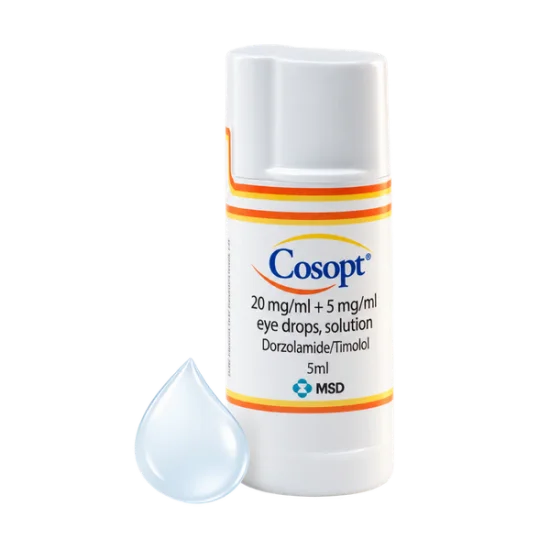
Cosopt
Active ingredient: Dorzolamide, Timolol
Delivery: from 4 days
- Only original products
- Worldwide Delivery
- 24/7 Support
Dorzolamide hydrochloride and timolol maleate, the active ingredients of Cosopt, are combined in ophthalmic drops for adults with elevated intraocular pressure. Cosopt reduces aqueous-humour production in open-angle glaucoma and ocular hypertension, helping protect the optic nerve and visual field.
Product information
Cosopt is a topical ophthalmic solution containing two pressure-lowering substances: dorzolamide hydrochloride, a carbonic anhydrase inhibitor, and timolol maleate, a beta-adrenergic blocking agent. The product is supplied as eye drops in a bottle and is used for intraocular pressure management in adults with open-angle glaucoma or ocular hypertension.
Therapeutic indications
Clinical indications for intraocular pressure management
Open-angle glaucoma develops when damage to the optic nerve is associated with pressure-related stress inside the eye. Ocular hypertension describes raised intraocular pressure without established glaucomatous optic-nerve damage. Both conditions require assessment of pressure, optic-nerve appearance and visual-field status.
Lowering intraocular pressure can reduce the risk of progressive visual-field loss. Cosopt is used for this purpose in adults, with the treatment plan adjusted to the patient’s eye pressure, other eye drops and general health. The FDA prescribing information describes the combination as a treatment for elevated intraocular pressure in open-angle glaucoma and ocular hypertension [1].
How it affects the body
Dorzolamide and timolol lower pressure through separate biological pathways. Dorzolamide hydrochloride acts locally in the ciliary body, while timolol maleate blocks beta-adrenergic stimulation that normally encourages aqueous-humour production.
The two components complement each other:
- Dorzolamide hydrochloride inhibits carbonic anhydrase, reducing bicarbonate formation and fluid transport into the eye.
- Timolol maleate blocks beta-adrenergic receptors, reducing stimulation of aqueous-humour secretion.
- Cosopt combines both effects in one ophthalmic solution, reducing the number of separate administration steps.
The pressure-lowering action is not based on increasing fluid drainage. Its main effect is a reduction in fluid production by the ciliary processes. The electronic Medicines Compendium (emc) product information for dorzolamide and timolol describes the components as complementary agents for reducing intraocular pressure [2].
Role of carbonic anhydrase inhibition
Carbonic anhydrase helps support bicarbonate-dependent ion movement in the ciliary epithelium. This movement contributes to aqueous-humour formation. Dorzolamide inhibits the relevant enzyme, reducing the transport of sodium and fluid into the posterior chamber of the eye.
The result is lower aqueous-humour secretion and a reduction in intraocular pressure. Dorzolamide can also be absorbed systemically after topical use, which explains why patients with severe kidney impairment require special assessment.
Contribution of beta-adrenergic blockade
Timolol blocks beta-adrenergic receptors in the ciliary body. This reduces the biochemical signals that promote aqueous-humour production. Although the drop is applied to the eye, some timolol can enter the bloodstream through the conjunctiva and nasal passages.
When not to use it
Cosopt is not suitable for everyone. This medication is not for you if you have a known allergy to dorzolamide, timolol, related beta-blockers or any component of the solution.
Specific conditions requiring avoidance or careful clinical assessment include:
- Bronchial asthma or a history of severe asthma.
- Severe chronic obstructive pulmonary disease.
- Sinus bradycardia.
- Second- or third-degree atrioventricular block without a functioning pacemaker.
- Overt heart failure.
- Cardiogenic shock.
- Severe renal impairment.
- Previous serious reactions to sulfonamide-derived medicines.
- Certain corneal, ocular-surface or eye-surgery complications.
Cosopt can interact with systemic beta-blockers, other beta-blocker eye drops, calcium-channel blockers such as verapamil or diltiazem, cardiac glycosides, antiarrhythmics and medicines that lower blood pressure. Oral carbonic anhydrase inhibitors may increase exposure to the same pharmacological pathway. Medicines that affect CYP2D6 may increase beta-blocker-related effects in some patients.
When this is not for you
Tell the prescribing clinician about asthma or breathing disease, a slow pulse, heart rhythm problems, heart failure, kidney disease, diabetes, thyroid disease and planned eye surgery. Pregnancy and breastfeeding require an individual benefit-risk assessment because both active ingredients can produce systemic effects after topical use.
Possible side effects
Cosopt can cause local eye irritation and systemic beta-blocker effects. The most frequently reported problems include burning or stinging after application, blurred vision, tearing, itching, dry eyes and an unusual taste.
Other possible reactions include:
- Redness of the eye or eyelids.
- Inflammation of the cornea or conjunctiva.
- Light sensitivity.
- Eyelid swelling.
- Headache or fatigue.
- Dizziness.
- A slower pulse or lower blood pressure.
- Shortness of breath or wheezing in susceptible people.
- Nausea or gastrointestinal discomfort.
Blurred vision immediately after a drop is common enough to affect driving decisions. Vision should be clear before driving or using machinery. Persistent eye pain, marked redness, sudden vision change, severe wheezing, fainting or a very slow heartbeat requires prompt medical assessment.
Timolol may mask some physical signs of low blood glucose, such as a fast heartbeat. People using insulin or other glucose-lowering treatment should know this before starting therapy. Dorzolamide can produce a bitter taste because some liquid drains through the tear duct into the throat.
A contact-lens wearer may experience more irritation from preservatives. Removing lenses before use and replacing them after the recommended interval can improve comfort. If irritation continues, the clinician may assess the ocular surface and the suitability of the preservative system.
Ingredients
Cosopt is a topical ophthalmic solution containing two pressure-lowering substances: dorzolamide hydrochloride, a carbonic anhydrase inhibitor, and timolol maleate, a beta-adrenergic blocking agent. The product is supplied as eye drops in a bottle and is used for intraocular pressure management in adults with open-angle glaucoma or ocular hypertension. The dose is decided individually, taking age, other medicines and health conditions into account.
| Product feature | Cosopt |
|---|---|
| Active ingredients | Dorzolamide hydrochloride and timolol maleate |
| Concentration and form | Ophthalmic solution |
| Route and pack size | Topical eye administration; 5 ml bottle |
Dosage and administration
The usual adult regimen is one drop in the affected eye or eyes twice daily. The dose is decided individually, taking age, other medicines and health conditions into account. Cosopt is administered as an eye drop, not swallowed or applied to the skin.
- Wash and dry the hands before administration.
- Tilt the head back and gently pull down the lower eyelid.
- Place one drop into the conjunctival sac without touching the eye or eyelashes with the bottle tip.
- Close the eye gently after administration.
- Press the inner corner of the closed eye near the nose for approximately two minutes.
- Replace the cap without rinsing the dropper tip.
- Use separate timing from other ophthalmic medicines when directed.
The treatment duration depends on the pressure response and the clinician’s assessment of the optic nerve and visual field. Cosopt should not be used more often than prescribed. Increasing the number of drops does not produce a proportional benefit and may increase adverse effects.
If contact lenses are worn, remove them before administration and wait at least 15 minutes before putting them back. Cosopt may contain a preservative that can be absorbed by soft contact lenses.
Missed administration
Apply the missed dose when remembered unless the next scheduled dose is close. If the next dose is due soon, skip the missed dose and return to the regular schedule. Do not double the amount to compensate.
Comparison
The clinically relevant comparison is between treatment approaches rather than retail brands. Cosopt is a fixed combination of a topical carbonic anhydrase inhibitor and a topical beta-blocker. Other options may involve one active ingredient, a different fixed combination or a separate add-on drop.
| Treatment approach | Main pharmacological feature | Clinical consideration |
|---|---|---|
| Cosopt fixed combination | Dorzolamide plus timolol | Two pressure-lowering mechanisms in one bottle |
| Single-agent therapy | One pressure-lowering mechanism | May be suitable when one agent controls pressure |
| Separate combination therapy | Different drops administered individually | Allows more flexibility but adds administration steps |
Substitution requires review of the active ingredients, dosing schedule, intraocular-pressure target and medical history. A product with a similar purpose may still have a different contraindication profile, preservative system or dosing frequency.
Common mistakes
Several routine mistakes can reduce the benefit of Cosopt or increase exposure to timolol:
- Using the drops only when the eyes feel uncomfortable.
- Adding extra drops after a missed dose.
- Touching the bottle tip against the eye or eyelashes.
- Applying multiple eye drops immediately one after another.
- Forgetting to remove contact lenses.
- Continuing to drive while vision remains blurred after administration.
- Failing to mention asthma, slow pulse or heart medicines.
- Stopping treatment after one normal pressure reading.
- Confusing a temporary stinging sensation with treatment failure.
- Sharing the bottle with another person.
Cosopt is intended for the individual patient for whom it was prescribed. A bottle should not be transferred between people with glaucoma or ocular hypertension because their diagnoses, pressure targets and contraindications may differ.
What doctors say
In clinical practice, pressure control is judged by more than a single reading. Ophthalmologists consider the target intraocular pressure, optic-nerve appearance, retinal nerve-fibre layer, visual fields, age, family history and the speed of any progression.
A physician would usually explain that Cosopt controls pressure but does not restore optic-nerve fibres already lost. The aim is to reduce future damage through regular treatment and scheduled monitoring. The American Academy of Ophthalmology places pressure reduction, adherence and follow-up examination at the centre of glaucoma care [3].
Patients sometimes stop drops after a normal pressure reading. That reading may reflect the treatment working. Glaucoma can remain symptom-free while damage progresses, so the absence of pain or blurred vision does not show that pressure control is no longer needed.
Another clinical issue is administration technique. If the drop lands on the cheek rather than in the eye, the delivered dose may be inadequate. If the bottle tip touches the eye, eyelashes or skin, contamination becomes possible and the bottle should be handled carefully.
Common questions
Can Cosopt affect driving, concentration or machinery work?
Cosopt may cause temporary blurred vision, eye discomfort, dizziness or fatigue, especially soon after administration. The FDA product information from 2023 describes these effects and the potential for systemic absorption of timolol. Wait until vision is clear and you feel alert before driving, operating machinery or performing work requiring precise concentration. The risk is higher when another medicine also lowers blood pressure or slows the pulse. Avoid driving until any visual or cardiovascular symptoms have settled.
Is Cosopt suitable for people under 18?
Cosopt is generally used in adults, and paediatric use requires specialist assessment. The electronic Medicines Compendium (emc) product information available in 2024 describes the established indication in adults rather than routine self-directed use in children. A child with glaucoma or raised intraocular pressure needs assessment by an ophthalmologist because causes, dosing and preservative tolerance can differ from those in adults. Do not use an adult bottle for a child without a specific prescription.
What should I do after missing a Cosopt dose?
Apply the missed drop when you remember unless the next scheduled administration is close. The FDA prescribing information from 2023 supports returning to the normal schedule rather than doubling the dose. Two drops at once do not replace the missed treatment and may increase local irritation or systemic timolol exposure. If missed doses occur frequently, a written morning-and-evening routine can help.
What happens if Cosopt is stopped, and is tapering required?
Stopping Cosopt can allow intraocular pressure to rise again because the medicine controls aqueous-humour production only while it is being used. Guidance from NICE, updated in 2022, treats glaucoma pressure management as a continuing plan based on pressure targets and optic-nerve risk. Some patients may need a replacement drop or another treatment rather than abrupt discontinuation. Tapering is not a universal requirement for this ophthalmic combination, but the prescribing clinician should decide how treatment changes.
What should be discussed before starting Cosopt?
The relevant history includes asthma, chronic obstructive pulmonary disease, slow pulse, heart block, heart failure, kidney disease, diabetes, thyroid disease and previous reactions to eye drops. The WHO’s 2023 material on vision impairment supports early assessment and continuing management of conditions that threaten vision. Provide a complete list of eye medicines, oral beta-blockers, heart medicines and supplements. Planned eye surgery should also be mentioned because timolol can affect cardiovascular responses during anaesthesia.
Can Cosopt cause a slow heartbeat?
Yes. Timolol can enter the circulation after ocular administration and may slow the heart rate or lower blood pressure. The FDA label from 2023 identifies bradycardia, heart block and heart failure as important safety concerns for ophthalmic beta-blockers. Seek prompt assessment for fainting, severe dizziness, chest discomfort, unusual breathlessness or a markedly slow pulse.
Can Cosopt be combined with other medicines or supplements?
Cosopt can interact with other beta-blockers, calcium-channel blockers, cardiac glycosides, antiarrhythmics, blood-pressure medicines and oral carbonic anhydrase inhibitors. Electronic Medicines Compendium (emc) product information from 2024 also highlights the need to consider additive effects on heart rate, blood pressure and carbonic-anhydrase inhibition. Tell the prescriber about supplements that affect blood pressure or heart rhythm, even when they are sold without a prescription. Do not add another pressure-lowering eye drop without an agreed schedule.
Do you offer anonymous delivery?
Your order will be securely packed and shipped within 24 hours. This is exactly what your package will look like (images of an actual item sent). It has the size and look of a regular private letter (24x11x0.7 cm) and its contents cannot be seen.
How Buyers Rate Cosopt
-
Hassan, 45 Al Qusais · Several months 25 Oct 2026Rating: 4 out of 5I used Cosopt twice daily for several months. My follow-up pressure readings were much better, and I found one bottle simpler than managing two separate drops. The routine fitted easily around work.
-
Joseph, 36 Madinat Zayed · Within the first week 2 Nov 2026Rating: 4.5 out of 5I used the drops morning and evening, and noticed that my eyes felt less strained during long periods of reading after I started them. The bottle was easy to carry, and remembering the doses became automatic within the first week.
-
Sultan, 32 Ruwais · Several months 7 Nov 2026Rating: 5 out of 5I used Cosopt twice daily, and it helped keep my eye-pressure readings in the range my clinic wanted over several months. I did not need to think about separate dorzolamide and timolol bottles, which made the daily routine easier.
-
Vikram, 52 Al Majaz · Several months 12 Nov 2026Rating: 3.5 out of 5I used the drops twice daily for several months, and they helped reduce my pressure, although the first few applications caused a bitter taste and brief blurred vision. Pressing the inner corner of the eye improved the taste, but the treatment still required patience and regular follow-up.
-
Arjun, 41 Ras Al Khaimah · Several weeks 20 Nov 2026Rating: 2 out of 5I used Cosopt twice daily for several weeks, but it did not give me the pressure control expected from the first review, and I also felt unusually tired after using it. I stopped after discussing the symptoms with my doctor, who reviewed other treatment options.
Sources
- U.S. Food and Drug Administration (2023). COSOPT (dorzolamide hydrochloride and timolol maleate) ophthalmic solution prescribing information.
- electronic Medicines Compendium (emc) (2024). Cosopt 20 mg/ml + 5 mg/ml eye drops, solution — Summary of Product Characteristics (SmPC).
- American Academy of Ophthalmology (2020). Primary Open-Angle Glaucoma Preferred Practice Pattern®.
