
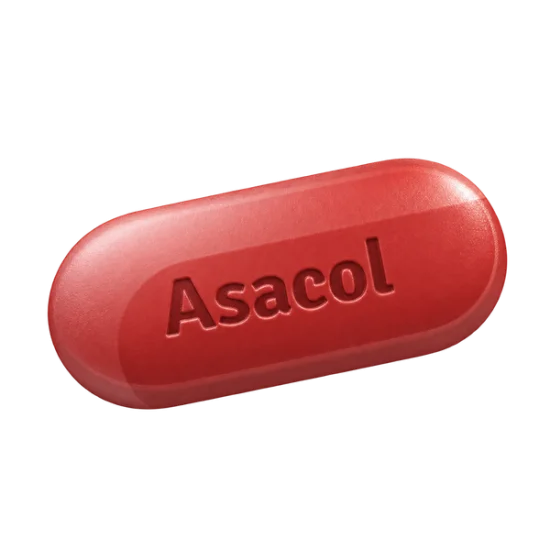
Asacol
Active ingredient: Mesalazine
Delivery: from 4 days
- Only original products
- Worldwide Delivery
- 24/7 Support
Mesalazine, the active ingredient in Asacol, is an anti-inflammatory treatment for adults with inflammatory bowel disease, including ulcerative colitis. Asacol uses a delayed- or modified-release design to deliver mesalazine to inflamed intestinal tissue, where it helps reduce mucosal inflammation.
Product information
Asacol contains mesalazine, also called mesalamine. It belongs to the 5-aminosalicylic acid, or 5-ASA, group of anti-inflammatory medicines.
Therapeutic indications
Asacol contains mesalazine, also called mesalamine. It belongs to the 5-aminosalicylic acid, or 5-ASA, group of anti-inflammatory medicines. Doctors prescribe it mainly for ulcerative colitis, a chronic condition that causes inflammation and ulceration in the lining of the large intestine.
The treatment may be used during an active flare to reduce symptoms such as:
- Frequent loose stools
- Rectal bleeding or mucus
- Urgency to open the bowels
- Abdominal discomfort
- Increased bowel frequency
Mesalazine can also support maintenance treatment after symptoms improve. The aim is to keep intestinal inflammation controlled and reduce the likelihood of another flare. The exact regimen depends on disease location, severity, formulation, kidney function, and the treatment plan selected by the prescriber.
Asacol targets inflammation within the gastrointestinal tract rather than acting as a general painkiller. It does not treat every cause of diarrhoea or abdominal pain, so persistent symptoms require medical assessment.
Primary medical applications
Asacol is used in the management of ulcerative colitis affecting the rectum, colon, or both. Some mesalazine formulations are also used for other inflammatory bowel conditions, but the approved indication depends on the specific formulation and local prescribing information.
The treatment is usually taken regularly, even when symptoms have settled. In clinical practice, stopping anti-inflammatory treatment as soon as bleeding improves is a common reason for relapse.
How it affects the body
Mesalazine works mainly at the surface of the intestinal lining. It reduces the production and activity of inflammatory mediators, including prostaglandins and leukotrienes, which contribute to swelling, tissue irritation, and mucosal injury.
The action is local. Only a limited amount needs to reach the bloodstream to affect the inflamed intestinal mucosa. This local approach helps explain why the formulation is designed to release mesalazine at a selected part of the gastrointestinal tract.
The modified-release design helps protect the active ingredient during passage through the upper digestive tract. It then releases mesalazine progressively or at a targeted intestinal site, depending on the product design.
Treatment decisions also take account of kidney safety, previous reactions to salicylates, and the severity and location of intestinal inflammation [1].
When not to use it
Asacol is not for you if you have had a serious allergic reaction to mesalazine, other 5-ASA medicines, or salicylates. Severe renal impairment requires specialist evaluation because mesalazine and its metabolites are cleared partly through the kidneys.
Caution is also needed with:
- Previous kidney disease or kidney stones
- Liver disease
- A history of blood disorders
- Asthma or marked sensitivity to aspirin-like medicines
- Active stomach or duodenal ulceration
- Pregnancy or breastfeeding
- Use of medicines that can affect kidney function
Severe hepatic impairment may also require an alternative treatment plan or closer monitoring.
The WHO identifies inflammatory bowel disease as a chronic condition requiring individualized therapy and follow-up rather than symptom-based self-treatment [2].
When this is not for you
Asacol is not suitable for everyone. Mesalazine can rarely cause kidney inflammation or a decline in kidney function, so renal assessment is relevant before treatment and during prolonged use. Monitoring may include serum creatinine, estimated glomerular filtration rate, and urinalysis, depending on the clinical situation.
A sudden reduction in urine, swollen ankles, flank pain, blood in the urine, or unusual fatigue can indicate a kidney problem. These symptoms need prompt medical assessment.
Possible side effects
Asacol is generally tolerated by many patients, but adverse effects can occur. Mild reactions may include:
- Headache
- Nausea
- Abdominal discomfort
- Indigestion
- Diarrhoea
- Flatulence
- Changes in bowel symptoms
These symptoms can overlap with ulcerative colitis itself, which makes timing useful. A new symptom that begins soon after starting treatment, becomes progressively worse, or differs from the usual flare pattern should be reported.
Rare reactions can be serious. Stop taking Asacol and seek urgent medical attention for:
- Severe skin rash, blistering, or peeling
- Swelling of the face, lips, tongue, or throat
- Breathing difficulty
- Severe abdominal pain with fever
- Persistent vomiting
- Marked weakness or confusion
- Chest pain or unusual shortness of breath
- Very low urine output
- Easy bruising, unexplained bleeding, or a severe sore throat
Mesalazine can rarely cause an acute intolerance syndrome that resembles worsening inflammatory bowel disease. Severe cramping, fever, headache, rash, and bloody diarrhoea after starting treatment need medical review rather than automatic dose escalation.
One practical detail is easy to miss: a headache may be mild and temporary, but a severe headache combined with rash, fever, or abdominal pain has a different significance. Another is that a rise in creatinine can occur without dramatic symptoms, which is why renal blood testing matters during prolonged treatment.
Ingredients
Asacol contains mesalazine, also called mesalamine. It belongs to the 5-aminosalicylic acid, or 5-ASA, group of anti-inflammatory medicines.
Equivalence of mesalazine and mesalamine
Mesalazine and mesalamine are two names for the same active pharmaceutical ingredient. “Mesalazine” is widely used in the United Kingdom, Europe, and several other regions, while “mesalamine” is common in North American medical references.
These names do not describe two different active substances. The formulation still matters because coatings and release systems determine where the ingredient becomes available in the intestine.
Dosage and administration
The regimen for Asacol is confirmed with a healthcare professional before treatment begins. A clinician selects the schedule according to the purpose of treatment, the severity and location of inflammation, previous treatment response, and kidney function.
General administration principles include:
- Take Asacol by mouth at the prescribed frequency.
- Swallow each capsule whole with water.
- Take doses at consistent times when possible.
- Do not crush, chew, split, or open the capsule unless specifically instructed.
- Continue the prescribed course during symptom improvement unless the prescriber changes it.
- Do not take extra capsules to compensate for a dose that was missed.
Food instructions can depend on the formulation. Follow the regimen provided for the specific Asacol product and strength. The active ingredient needs to reach the intended intestinal site, so changing the dosage form or timing without clinical guidance can affect treatment.
Patients sometimes judge treatment too quickly because rectal bleeding or urgency improves before the underlying inflammation has fully settled. Symptom improvement is encouraging, but it does not always mean that the disease is in remission.
Comparison
Mesalazine is one option within the wider treatment pathway for inflammatory bowel disease. The most suitable approach depends on disease severity, the affected bowel segment, previous response, and the presence of complications.
| Treatment approach | Main role | Key limitation |
|---|---|---|
| Mesalazine anti-inflammatory treatment | Mild to moderate intestinal inflammation and maintenance in suitable patients | May be insufficient for severe or rapidly worsening disease |
| Corticosteroid treatment | Short-term control of a significant flare | Long-term use causes important systemic adverse effects |
| Immunomodulating or biologic treatment | Moderate to severe disease or disease not controlled by simpler treatment | Requires specialist selection and monitoring |
Mesalazine has the advantage of acting locally in the bowel and is often used without the systemic steroid effects associated with corticosteroids. Its limitations include the need for regular use, possible kidney-related complications, and the fact that it may not control severe disease on its own.
Advantages and limitations
Potential advantages include local intestinal action, use during active disease and maintenance for suitable patients, and no usual need for a corticosteroid-style taper. A limitation is that mesalazine may be insufficient for severe disease and requires renal monitoring during prolonged treatment.
Common mistakes
Several practical errors can reduce the benefit of Asacol:
- Crushing or chewing the modified-release capsule
- Taking two doses after forgetting one
- Stopping treatment as soon as bleeding improves
- Using NSAIDs for abdominal pain without discussing kidney and bowel risks
- Missing renal blood tests during long-term therapy
- Assuming every episode of diarrhoea is a flare
- Ignoring reduced urine, rash, fever, or severe abdominal pain
- Changing the administration schedule without confirming the plan
Dehydration deserves attention during diarrhoeal illness. Reduced fluid intake, vomiting, or heavy sweating can increase kidney stress, especially when combined with medicines that affect renal blood flow.
What doctors say
In clinical practice, doctors usually set two separate goals: controlling the current inflammatory flare and maintaining remission afterward. The same medicine may be used for both purposes, but the regimen can differ.
A gastroenterologist would normally assess stool frequency, bleeding, urgency, weight, abdominal pain, blood tests, and sometimes faecal calprotectin. Symptoms alone do not always show how much inflammation remains. A patient may feel better while mucosal inflammation continues. Follow-up findings can guide changes to the dose or treatment approach. They can also help determine whether additional investigation is needed.
Kidney monitoring receives special attention during prolonged mesalazine treatment. A normal test before starting does not remove the need for later review, especially when the person is older, dehydrated, or taking medicines that affect renal function.
Patients should also tell the clinician if a capsule seems difficult to swallow, if bowel symptoms worsen after each dose, or if headaches and abdominal pain appear together. These details can help distinguish ordinary disease fluctuation from a medication reaction.
Common questions
Can Asacol be taken with painkillers or supplements?
NSAIDs such as ibuprofen and naproxen deserve caution because they may irritate the bowel and affect kidney function when combined with mesalazine. The EMA product information identifies renal monitoring as an important safety consideration for mesalazine treatment [3]. Provide a complete list of painkillers, vitamins, herbal products, and prescribed medicines before starting or adding treatment. The FDA prescribing information dated 2023 also advises reviewing concomitant medicines before mesalamine treatment.
What should be discussed with a doctor before starting Asacol?
Discuss previous reactions to mesalazine, mesalamine, aspirin, or other salicylates, along with kidney disease, liver disease, asthma, ulcers, pregnancy, breastfeeding, and blood disorders. Baseline renal testing may be appropriate, especially when treatment is expected to continue for an extended period. MOHAP guidance and local prescribing practice support individualized assessment for medicines used in chronic gastrointestinal disease. NICE guidance published in 2024 also supports treatment selection according to disease severity and patient factors.
Does Asacol need to be tapered when treatment stops?
Mesalazine itself does not usually require a corticosteroid-style taper. A clinician may still change or stop treatment in a planned way because the risk of ulcerative colitis returning depends on disease activity and the reason for treatment. The WHO describes inflammatory bowel disease as a chronic condition in which ongoing management may be needed after symptoms improve, so stopping should follow the agreed treatment plan. WHO information published in 2023 supports continued clinical follow-up for chronic inflammatory bowel disease.
How should Asacol be stored at home or during travel?
Keep the capsules in a dry place at ordinary room temperature, away from excessive heat and moisture. Avoid leaving them in a hot car, a steamy bathroom, or direct sunlight during travel. EMA product information for oral mesalazine products emphasizes preserving the dosage form and keeping medicines out of children’s reach; use a closed container and carry only the amount needed for the journey. The EMA product information dated 2024 also advises following the storage conditions for the specific formulation.
Which symptoms require stopping Asacol and seeking urgent medical help?
Urgent assessment is needed for facial or throat swelling, breathing difficulty, blistering rash, severe abdominal pain with fever, persistent vomiting, markedly reduced urine, chest pain, or unusual bleeding. These symptoms can signal a serious hypersensitivity reaction, kidney problem, or other complication rather than a routine flare. The EMA identifies hypersensitivity and renal reactions among the clinically significant warnings associated with mesalazine [4]. FDA labeling published in 2023 likewise describes serious hypersensitivity and renal warning signs.
Which condition rules out Asacol?
A previous serious allergic reaction to mesalazine, mesalamine, other 5-ASA medicines, or salicylates rules out treatment. Severe renal impairment also requires specialist review before use, because the medicine may not be suitable when kidney clearance is substantially reduced. A clinician must also assess severe hepatic disease, significant blood abnormalities, and a history of severe intolerance to similar anti-inflammatory treatment. NICE guidance from 2024 supports specialist assessment when comorbidities or severe treatment reactions may affect medicine selection.
Do you offer anonymous delivery?
Your order will be securely packed and shipped within 24 hours. This is exactly what your package will look like (images of an actual item sent). It has the size and look of a regular private letter (24x11x0.7 cm) and its contents cannot be seen.
How Buyers Rate Asacol
-
Rachel, 52 Ruwais · Several weeks 25 Oct 2026Rating: 4 out of 5I used the prescribed Asacol schedule for several weeks. The urgency eased first, then the bleeding settled, and I was able to plan normal mornings again. The improvement felt steady rather than sudden, which suited me.
-
Ayesha, 66 Ras Al Khaimah 1 Nov 2026Rating: 1.5 out of 5Asacol did not control my flare. My bowel movements remained frequent and I became exhausted, so I stopped trying to manage it on my own and contacted my doctor. The treatment was not the right answer for that episode.
-
Hannah V., 26 Sharjah · The first part of treatment 6 Nov 2026Rating: 3.5 out of 5The medicine reduced the bleeding, but the improvement was slower than I expected. I also had mild headaches during the first part of treatment. They passed, but the partial response meant my doctor had to review the plan.
-
Anjali, 36 Abu Dhabi · The maintenance period 16 Nov 2026Rating: 4 out of 5After following the prescribed schedule, I had fewer urgent trips to the bathroom and could return to work without constantly planning around toilets. I kept taking it during the maintenance period because the routine was easy to follow.
-
Fatima L., 44 Ajman · The first few weeks 20 Nov 2026Rating: 4.5 out of 5Asacol helped settle the bowel symptoms that had been interrupting my evenings. I noticed the difference gradually over the first few weeks, and the improvement made meals and daily activities much less stressful.
Sources
- European Medicines Agency (2024). Summary of Product Characteristics (SmPC) — mesalazine.
- World Health Organization (2023). Inflammatory bowel disease.
- European Medicines Agency (2024). Summary of Product Characteristics (SmPC) — mesalazine: interactions and precautions.
- European Medicines Agency (2024). Summary of Product Characteristics (SmPC) — mesalazine: adverse reactions and warnings.
