
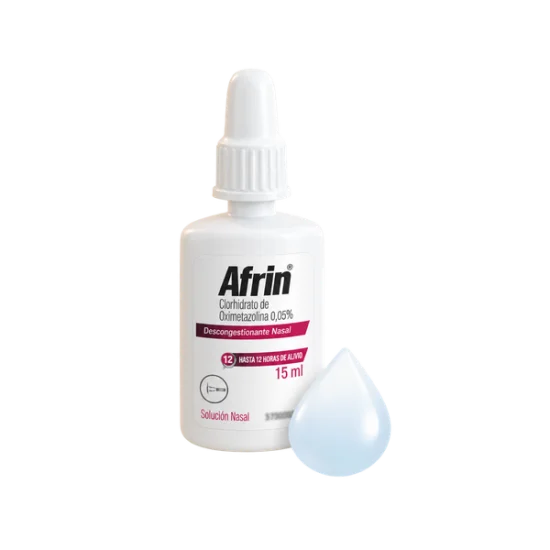
Afrin
Active ingredient: Oxymetazoline
Delivery: from 4 days
- Only original products
- Worldwide Delivery
- 24/7 Support
Afrin provides temporary relief from a blocked nose caused by colds, sinus congestion, or nasal swelling. Its active ingredient, oxymetazoline, narrows enlarged blood vessels in the nasal lining so air can pass more easily.
Product information
Its active ingredient, oxymetazoline, narrows enlarged blood vessels in the nasal lining so air can pass more easily.
Afrin is a nasal spray containing oxymetazoline hydrochloride, a topical nasal decongestant. The product is supplied as a spray in a bottle containing 15 ml. It is used for temporary relief of nasal congestion and sinus pressure associated with swollen nasal tissues.
The spray opens the nasal airway by reducing mucosal swelling. It does not remove the virus causing a cold, eliminate allergens, or cure sinusitis.
Primary Congestion Relief
Nasal congestion occurs when blood vessels and tissues inside the nose become enlarged. This can make breathing through the nose difficult and may create a feeling of pressure around the cheeks, forehead, or nose.
Afrin can reduce this swelling for a limited period. It may be useful when congestion is interfering with sleep, eating, or normal breathing through the nose. The benefit concerns airflow and pressure; it does not directly treat fever, infection, sneezing, itchy eyes, or thick mucus.
Oxymetazoline Decongestant Action
Oxymetazoline stimulates alpha-adrenergic receptors in the blood vessels of the nasal mucosa. The vessels constrict, meaning they become narrower. Less blood flow reaches the swollen nasal tissue, so the nasal passages can feel more open.
This local action explains why Afrin can work quickly. It also explains why excessive or prolonged use may irritate the nasal lining and cause congestion to return more strongly.
Therapeutic indications
Afrin is used for temporary relief of nasal congestion and sinus pressure associated with swollen nasal tissues.
Afrin can reduce blockage from swollen nasal tissue. It does not remove an allergen, replace saline rinsing, or treat bacterial infection.
Allergic swelling can narrow the nasal passages and create congestion. Afrin may temporarily reduce that blockage, allowing air to pass more freely through the nose.
Reduced nasal swelling may ease pressure caused by blocked drainage passages.
How it affects the body
Afrin acts mainly where it is sprayed. The nasal mucosa is the moist lining inside the nasal passages, and oxymetazoline reduces the blood-flow-related swelling within this tissue. Mucus, allergens, and infectious organisms remain present even when the airway feels clearer.
Oxymetazoline stimulates alpha-adrenergic receptors in the blood vessels of the nasal mucosa. The vessels constrict, meaning they become narrower. Less blood flow reaches the swollen nasal tissue, so the nasal passages can feel more open.
When not to use it
Caution is needed with hypertension, heart disease, thyroid disease, diabetes, glaucoma, prostate enlargement, pregnancy, and breastfeeding.
People taking other decongestants, monoamine oxidase inhibitors, stimulant medicines, or drugs affecting blood pressure need specific interaction advice before use.
Uncontrolled hypertension, significant heart disease, narrow-angle glaucoma, hyperthyroidism, and some prostate conditions can make oxymetazoline unsuitable without clinical direction. A history of sensitivity to oxymetazoline or another ingredient also rules out use.
When this is not for you
NOT for you if you have uncontrolled hypertension, significant heart disease, narrow-angle glaucoma, hyperthyroidism, or a relevant interaction unless a clinician has advised use.
Children require age-appropriate products and directions. Adult nasal sprays should not be assumed suitable for a child.
Possible side effects
Afrin can provide rapid airflow improvement, but local irritation and rebound congestion limit its role. Nasal administration does not completely prevent systemic effects, especially when the product is used excessively or swallowed after draining into the throat.
Common Local Reactions
Possible local effects include:
- Nasal dryness
- Burning or stinging
- Sneezing
- Irritation
- Increased discharge
- Minor nosebleeds
Persistent burning, frequent bleeding, or worsening blockage warrants review of the treatment approach. Directing the spray away from the septum and avoiding unnecessary repeat applications may reduce irritation.
Cardiovascular and Systemic Precautions
Oxymetazoline can affect blood vessels beyond the nose in susceptible people. The FDA describes cardiovascular and central nervous system warnings for topical nasal decongestants, including possible palpitations, nervousness, and blood-pressure effects [1].
Ingredients
Afrin is a nasal spray containing oxymetazoline hydrochloride, a topical nasal decongestant. The product is supplied as a spray in a bottle containing 15 ml.
Dosage and administration
Afrin is administered through the nose. The exact amount and frequency vary by product strength, age group, and individual circumstances, so there is no single amount that suits everyone.
- Clear the nose gently before administration.
- Keep the head upright.
- Place the nozzle at the nostril without forcing it deeply.
- Aim slightly away from the nasal septum, the central wall between the nostrils.
- Do not increase the number of sprays when relief feels incomplete.
- Do not share the bottle between people.
Rebound Congestion Prevention
Rhinitis medicamentosa is congestion caused or worsened by repeated topical decongestant use. The nose may initially improve, then become blocked again when the effect fades. Increasing the frequency can create a cycle of temporary relief followed by worsening blockage.
Use Afrin for the shortest period permitted by the product directions. Anyone who has been using it longer than directed should obtain specific guidance about stopping and managing the resulting congestion.
Comparison
Afrin and saline products work differently. Afrin constricts swollen blood vessels, while saline mist moistens the nasal lining and can help loosen mucus and surface irritants. Nasal irrigation physically flushes mucus and allergens from the nasal passages when performed correctly.
| Approach | Main action and suitable role |
|---|---|
| Afrin nasal spray | Short-term reduction of nasal tissue swelling; rebound congestion is possible with prolonged use |
| Saline mist or moisturising gel | Moisture, mucus loosening, and relief of dryness; no topical vasoconstrictor action |
| Nasal irrigation | Rinsing mucus and irritants; requires safe water and careful device hygiene |
Saline sprays may be useful for dryness, routine mucus clearance, or people who need to avoid topical vasoconstrictors. They are not pharmacologically equivalent to oxymetazoline and may not open a severely swollen nose as quickly.
Saline Mist and Moisturising Options
Saline mist can help hydrate the nasal lining and loosen secretions. Moisturising gels may be useful when dryness or crusting is the dominant complaint. These options generally do not carry the same rebound-congestion concern as oxymetazoline.
Nasal Irrigation Systems
Irrigation devices can help remove mucus and allergens from the nasal passages. Use distilled, sterile, or previously boiled and cooled water when preparing an irrigation solution. Ordinary untreated tap water is unsuitable for nasal irrigation.
Common mistakes
Frequent mistakes include:
- Using extra sprays because the first application feels insufficient.
- Continuing the spray for weeks instead of treating it as short-term relief.
- Spraying directly onto the nasal septum.
- Sharing the bottle.
- Assuming a scented night product is a sleep medicine.
- Using a decongestant for severe facial swelling or breathing difficulty.
- Treating persistent allergy symptoms with a decongestant alone.
What doctors say
Doctors generally view topical oxymetazoline as a short-term symptom-control option rather than long-term treatment. Its value is greatest when swelling is the main barrier to nasal breathing and the duration of use remains limited.
The EMA’s scientific information on nasal decongestants describes the need to consider local irritation, cardiovascular effects, interactions, and rebound congestion when using sympathomimetic products [2]. That balance is practical: fast relief can be useful, but repeated exposure may create a new problem.
A clinician would also look for the reason behind recurring congestion. Allergy treatment, saline care, environmental changes, or evaluation of sinus and nasal structure may provide a more suitable long-term plan.
Common questions
Is Afrin suitable during pregnancy or breastfeeding?
Pregnancy and breastfeeding require individual assessment before using oxymetazoline. The local action may limit systemic exposure, yet blood-vessel effects and the cause of congestion still matter. FDA pregnancy and lactation information for nasal decongestants supports using the shortest necessary exposure and considering non-drug measures first [3]. Saline mist and appropriately prepared irrigation may be discussed as alternatives when suitable. FDA pregnancy-labeling guidance published in 2014 supports individualized risk assessment when medicines are considered during pregnancy. This review should include the expected benefit, possible risks, and non-drug options.
How should Afrin be stored at home or during travel?
Keep Afrin closed, away from excessive heat, direct sunlight, and freezing conditions. During travel, protect the bottle from leakage and avoid leaving it in a hot vehicle. The WHO guidance on medicine storage emphasises protecting medicines from heat, moisture, and contamination. Keep the spray where children cannot access it. WHO medicine-storage guidance published in 2022 emphasizes protection from heat, moisture, and contamination.
How long can Afrin be used?
Afrin is intended for short-term use, and the maximum course depends on the specific product directions. Long-term or repeated use can cause rhinitis medicamentosa, in which congestion returns or worsens after the decongestant wears off. The FDA recognises prolonged topical decongestant use as a cause of rebound nasal congestion. A person already using Afrin beyond the recommended period needs a planned approach to stop and manage symptoms. FDA labeling information dated 2023 identifies prolonged topical decongestant use as a reason for caution.
How soon should Afrin start working?
Oxymetazoline often begins improving nasal airflow relatively quickly because it acts directly on swollen nasal blood vessels. The timing and degree of relief vary with the cause of congestion and the individual response. Product information reviewed by the EMA describes oxymetazoline as a topical vasoconstrictor with temporary action. Lack of benefit after correct administration should not lead to repeated extra sprays. EMA product information from 2021 describes oxymetazoline as a topical vasoconstrictor intended for temporary relief.
Can Afrin be combined with other decongestants or blood-pressure medicines?
Combining Afrin with another nasal or oral decongestant can increase exposure to vasoconstrictor effects. Caution also applies to medicines that affect blood pressure, stimulant medicines, and monoamine oxidase inhibitors. FDA safety information identifies possible cardiovascular and nervous-system effects with sympathomimetic decongestants. A pharmacist or clinician should review the exact medicines before combined use. FDA safety information dated 2023 describes cardiovascular and nervous-system precautions for sympathomimetic decongestants.
Which condition rules Afrin out?
Uncontrolled hypertension, significant heart disease, narrow-angle glaucoma, hyperthyroidism, and some prostate conditions can make oxymetazoline unsuitable without clinical direction. A history of sensitivity to oxymetazoline or another ingredient also rules out use. MOHAP medicine-safety principles support checking relevant medical conditions and concurrent treatment before using medicines with cardiovascular effects. Children should receive only age-appropriate products and directions. MOHAP medicine-safety guidance published in 2022 supports checking medical conditions and concurrent treatment before use.
Which symptoms mean stopping Afrin and seeking urgent care?
Stop using Afrin and seek urgent care for chest pain, severe palpitations, fainting, serious breathing difficulty, facial or throat swelling, or sudden vision changes. Severe headache with weakness, confusion, or other neurological symptoms also requires immediate assessment. The WHO identifies severe unexpected reactions and breathing or cardiovascular symptoms as reasons for urgent medical attention. Persistent congestion without emergency symptoms still needs review if it continues beyond the expected short course. WHO safety guidance published in 2022 supports prompt assessment of serious unexpected reactions and breathing or cardiovascular symptoms.
Do you offer anonymous delivery?
Your order will be securely packed and shipped within 24 hours. This is exactly what your package will look like (images of an actual item sent). It has the size and look of a regular private letter (24x11x0.7 cm) and its contents cannot be seen.
No-Drip and Night Formulations
No-drip designs aim to improve the delivery experience by limiting liquid running into the throat. This is a feature of administration, not proof of stronger decongestant action.
Common Patient Mistakes and Practical Corrections
A blocked nose can encourage repeated use because the initial relief feels immediate. The safer approach is to use the recommended administration schedule and avoid treating every return of congestion with an additional spray.
Another common error is assuming that a clearer airway means the underlying illness has resolved. A cold, allergy, or sinus condition can continue while the nasal passages temporarily feel open.
People also sometimes use the spray for symptoms it cannot address. Watery eyes, itching, sneezing, persistent fever, and thick discoloured mucus may need a different assessment. Nasal congestion with chest tightness or lower-airway wheezing is outside the usual role of a nasal decongestant.
How Buyers Rate Afrin
-
Rachel, 36 Ajman · One day 25 Oct 2026Rating: 2.5 out of 5I used the directed number of sprays for one day during a heavy cold, but Afrin did not give me enough relief to make a real difference. My nose stayed blocked, so I stopped using it rather than continuing to add sprays.
-
Grace, 45 Al Ain · Several nights 3 Nov 2026Rating: 4.5 out of 5Afrin opened my nose noticeably within a short time during a cold. I used the directed number of sprays for several nights and was satisfied that I could breathe more comfortably in bed.
-
Priya, 45 Dibba Al-Fujairah · Several days 10 Nov 2026Rating: 4.5 out of 5The spray helped with the pressure and blocked feeling I had during sinus congestion. I used the directed number of sprays for several days, and the improvement was clear. I liked that I did not need a large amount to feel the effect.
-
Hannah, 64 Al Reem Island · The short period recommended 23 Nov 2026Rating: 5 out of 5Afrin gave me useful temporary relief when my nose was badly blocked. I used the directed number of sprays for the short period recommended and found breathing through my nose much easier afterward.
Sources
- U.S. Food and Drug Administration (2023). Oxymetazoline hydrochloride nasal spray — Drug Facts label.
- European Medicines Agency (2021). Summary of Product Characteristics (SmPC) — oxymetazoline nasal spray.
- U.S. Food and Drug Administration (2014). Pregnancy, Lactation, and Reproductive Potential: Labeling for Human Prescription Drug and Biological Products.
